Categories
Notes from the field Uncategorized

Notes from the Field: North Wales, United Kingdom

Every fortnight (or so we hope) we feature a seagrass meadow from around the world. This week, Rosemary Mc Closkey writes about her field site in Porth Dinllaen in North Wales. Rosemary is currently a Masters student at Swansea University and she is studying juvenile fish populations in Zostera marina meadows. 

——————————————————————-

Photos and text by Rosemary Mc Closkey

I am a student from Swansea University and I am currently undertaking a month of field work for my Master’s thesis, where I am studying juvenile fish populations in a Zostera marina seagrass meadow in Porth Dinllaen on the Llŷn peninsula, North Wales. My data collection has been carried out alongside and with the support of an on-going collaborative project between SEACAMS and the National Trust here in Wales.

Seagrass bed at Porth Dinllaen on low water

I first visited the site with SEACAMS at the end of April this year to assist with their fish monitoring work and to assess some scarring of the bed caused by moorings in the bay. This also allowed me to get the ‘lay of the land’ so to speak, and to design the methodology for my project. I joined SEACAMS once more in June to carry out more work and to run trials on some small fish traps designed to catch shrimp and small fish. Unfortunately these yielded very little success and as I had yet to visit this site on the low spring tides, I was keen to return for an extended period so I could get a real feel for the site and to adjust my method.  Myself and a field assistant returned to Porth Dinllaen at the start of August with a smaller, lighter seine net with a finer mesh than that which I had used with SEACAMS in April and June. These nets seem to be working successfully and selecting the age/size classes that I wanted.

My research thus far is focused on assessing sites of varying complexity and heterogeneity within the meadow in order to elucidate whether small-scale variations within the bed affects species assemblages. During the 1st week of August, low water on spring tide caused the bed to become exposed, thus allowing some assistants and myself to carry out a habitat assessment.

Carrying out habitat assessment on the Z. marina bed

Plots of 36m2 were assessed and permanently marked out using marker pegs and GPS. Detailed photographs were also taken. I was initially skeptical as to whether or not the heavy duty orange pegs I had used to mark out the plots would last, but I was pleasantly surprised to see most of them have. They have proven very useful for relocating each plot. The main working hazard in that respect has been young kids stealing them for their sandcastles!

I have fished within each of the plots using an 8m beach seine net to assess the dominant species and size classes of juvenile fish. Initially I wasn’t sure whether I would catch the same species that were caught in the much larger seine net. I have found that I am catching all the same species as before, however the majority are juveniles, small fish and shrimps. The larger, fast moving finfish and bigger predators seem to evade the smaller net! The majority of the fish caught were wrasses, gobies, dragonets, sea scorpions, plaice, sticklebacks and pollack. We have also caught the slightly more elusive species such as little cuttlefish and pipefish.

Greater pipefish (Syngnathus acus). One of the many beautiful creatures in the Porth Dinllaen seagrass bed.

I plan to stay one more week at this beautiful location to collect some more fishing data. Getting access to the site for this length of time has been a real joy and I have been very fortunate to be able to carry out extended field work of this nature for my masters project. I look forward to returning to Swansea in order to write up my results and my thesis.

For more information on The National Trust: http://www.nationaltrust.org.uk/
For more information on SEACAMS: http://www.swan.ac.uk/seacams/
Categories
Notes from the field

Notes from the field: Reflections from down under

22nd May is International Day for Biodiversity and the theme for 2012 is Marine Biodiversity. In celebration, we will be featuring a series of articles on seagrass. This week, Michael Durako writes about his experiences visiting North Queensland, Australia.
———————————————————-

Photos and text by Michael J. Durako  

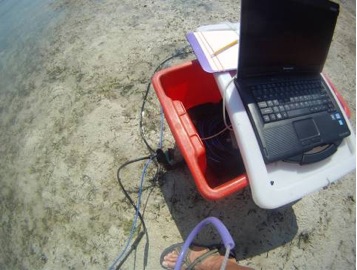
During the Fall 2011 semester while on research reassignment from my University, I spent 5 weeks with the Marine Ecology Group (MEG), Fisheries Queensland in Cairns hosted by Dr. Robert Coles, Dr. Michael Rasheed and my former student Katie Chartrand.  During this research visit I focused on assessing changes in leaf spectral reflectance as an indication of seagrass physiological condition, specifically in response to light and desiccation stress. During my visit I was able to sample two relatively pristine sites on Green Island, which is 24 km offshore of Cairns, and several highly-impacted sites in Gladstone Harbour, which is 250 km north of Brisbane.  Before departing for Cairns I was able to assemble a field compatible spectral reflectance system to obtain spectral reflectance measurements in situ using, with the help of Randy Turner and Lance Horn at the University of North Carolina Wilmington Center for Marine Science. The system consisted of a 25m long optical fiber reflectance probe connected through a variable neutral density filter to an Ocean Optics spectrometer with data acquisition controlled by OOI Spectra Suite software via a waterproof external switch and a Panasonic Toughbook PC.

Figure 1. Ocean Optics reflectance setup at Green Island.

 After calibration and testing the reflectance measurement system at the Northern Fisheries Center in Cairns, I set up a short-term shading experiment on Green Island. Shades, which reduced irradiance by 70%, were placed over Halophila ovalis (Hov) and Thalassia hemprichii (Th) located along the inner fringe of a seagrass bed on the south side of the island. The spectral reflectance of leaves of these two species were compared between adjacent full-sun and shaded plots from 0800 to 1400h to determine if this bio-optical characteristic exhibited short-term diurnal changes in high and low light treatments. The resulting reflectance spectra showed significant species, time and treatment differences.

Figure 2. Shade plots over Halophila ovalis and Thalassia hemprichii at Green Island.

 During my visit, I was very fortunate to be able to participate in an aerial (helicopter) seagrass survey trip to Mourilyan Harbor, 80 km south of Cairns. Because of the high tidal range (4 m), turbid water and presence of saltwater crocodiles, aerial survey techniques are broadly used by MEG in their seagrass assessment work in northern Queensland. This aerial approach may be applicable and more efficient for some of our FHAP sampling sites in Florida Bay. We were able to sample 126 sites in about 2 hours and never got our feet wet!

Figure 3. Hovering (altitude 1m) at a seagrass sampling site in Mourilyan Harbor. Helen Taylor of MEG is entering the GPS location of the sampling station on an ARC GIS map using a touchscreen PC. Carissa Fairweather is communicating sampling information to the pilot. My job was to enter the seagrass data on the field datasheets.

 I visited Gladstone Harbor over Sept 27-29th as part of a compliance sampling trip for Queensland Fisheries. During this trip I compared the spectral reflectance of submerged versus exposed seagrasses at four sampling sites: Pelican North, Whiggins, Fisherman’s Island and Pelican South.  Because of the large tidal range (3-4m) and high turbidity, we could only sample during the afternoon low tides. Reflectance data indicated distinct spectra between submerged and exposed leaves for both Zostera capricorni and Halophila ovalis at all four sites (see example spectra in Fig. 6; note separation of spectra from 500-680nm).

 Figure 4. Launching the Fisheries Queensland R/V Halophila at Gladstone Harbor.

Figure 5. Sampling exposed Zostera capricorni at Pelican South, Gladstone Harbor.

 Figure 6. Normalized reflectance of submerged (wet) versus exposed (Dry) Zostera capricorni at North Pelican, Gladstone Harbor.

 Near the end of my visit, I was able to visit Green Island again. My plan was to repeat the shading study in another location on the Island.  However, because of an early occurrence of Irukandji jellyfish, which are extremely venomous, the island was closed to swimming, within an hour of my arrival on the island. One of the resort divers was stung on the lip (she had on a stinger suit) and had to be MediVaced off the island by helicopter. Thus, I had to limit my sampling to only low tide. To make lemonade from lemons, I revised my sampling to be similar to what I had done in Gladstone Harbor.  I compared the spectral reflectance of submerged and exposed Thalassia hemprichii and Halophila ovalis.  The reflectance spectra were again distinct between species and between submersed and emersed shoots, although the differences were more subtle than those at Gladstone.  The results from this short field visit suggest that spectral reflectance provides a rapid assessment method that is sensitive to changes in seagrass physiological condition and it provides another tool in our arsenal of non-invasive physiological ecoindicators.

Figure 7. Measuring spectral reflectance of exposed Halophila ovalis at Green Island.

Categories
Notes from the field

Notes from the Field: Tinggi Island, Peninsular Malaysia

Every fortnight we feature a seagrass meadow from around the world. This week, Jillian Ooi writes about Pulau Tinggi, an island off the east coast of Peninsular Malaysia. Jillian has just recently completed her PhD at the University of Western Australia in Perth and is now based at the University of Malaya, in Kuala Lumpur.When she’s not grass-watching, she plays the gamelan with Rhythm in Bronze, a gong chime ensemble in Malaysia.
—————————————–
By Jillian Ooi
Photos courtesy of Affendi Yang Amri and Serina Rahman.

The first time I ventured into the seagrass meadows of Pulau Tinggi was in 2005. Back then, we were tracking the movement of dugongs in the area, but I became absolutely enchanted by the meadow itself.

It was like a magical garden filled with wonderful critters everywhere I looked. Golden sea cucumbers, knobbly sea stars, sea hares, green turtles, black tip sharks, and my favourite – the gobiid fishes and their associated burrowing shrimps, are some of the reasons I jumped at the chance of going back there for my PhD in seagrass biogeography three years later.

Pulau Tinggi is a marine park island located 12 km off the southeast coast of Peninsular Malaysia. In Malay, tinggi means ‘tall’. This island was named for its 600 m high peak shaped like a Mandarin’s hat. In olden days, Pulau Tinggi was a stopover point for spice traders. Today, it is sparsely inhabited and relatively undeveloped (i.e. no large luxury resorts as of 2010, although I hear plans are underway for some).

Pulau Tinggi, located off the southeast coast of Peninsular Malaysia, has a rich seagrass system in the forereef zone.
Our trusty boat, Gloria, skippered by Eddie, a local villager. In the background is the high peak of Pulau Tinggi.

Its villagers rely on home-stay programmes targeted mainly at recreational fishermen.  Its seagrass meadows are really something else. Mixed stands of Halophila ovalis, Halophila decipiens, Halophila minor, Halophila spinulosa, Halodule uninervis, Syringodium isoetifolium and Cymodocea serrulata grow in the area between the coral reef and sea. These forereef meadows are interesting because they comprise mainly small, fast-growing species growing in deeper waters and on unconsolidated sandy substrate. In most other Southeast Asian meadows, back reef meadows dominated by Enhalus acoroides and Thalassia hemprichii are the better known systems (Ooi et al 2011, Estuarine, Coastal and Shelf Science).

Cuttlefish found in seagrass meadows of Pulau Tinggi


Gobiid fish and burrowing shrimps

We found numerous dugong feeding trails, and frequently sighted dugongs surfacing around our boat. As a result, colleagues working on the Dugong dugon are now starting to turn their attention towards the Pulau Tinggi group of islands. Burrowing shrimp mounds are also common, and I was finding new mounds created almost daily in my study plots. Does this type of small-scale sediment burial kill the seagrasses? Yes it does, if a mound stays intact for at least 4 weeks. However, burial has more of an effect on small and ‘selfish’ species such as Halophila ovalis and Halodule uninervis (Ooi et al 2011, Continental Shelf Research). In comparison, larger species such as Cymodocea serrulata and Syringodium isoetifolium appear to survive burial better because they transfer resources to buried shoots.


So far, the main seagrass meadows on the south-western side of Pulau Tinggi have been mapped using tow underwater video in 2009. Plans are in place to set up permanent monitoring sites in the coral reefs and seagrass meadows to collect long-term data. Together with collaborators at the University of Western Australia, we are also continuing to develop models to understand the distribution patterns of the main seagrass species in relation to sediment properties.

The underwater world is not the only reason for my fond memories of Pulau Tinggi. We lodged with a local family who took us out to sea, filled our dive tanks, let us watch the World Cup on their TV, and welcomed us at a family member’s wedding.

Research facilities were basic, but I managed by converting the family’s grocery shop into a makeshift lab. The matriarch, Maksu, kept our spirits up by plying us with freshly-caught fish and sambal belachan, chilli donuts, fried bananas, fresh coconut juice, pressed rice topped with a thick chilli peanut sauce, durian porridge, and keropok lekor (something like a fish sausage is how I would describe it). On days off, we’d trek to our private waterfall to soothe our aching muscles and visit the resident Malayan soft-shelled turtle there.

But what does the future hold for the seagrasses in Pulau Tinggi? There are plans for a luxury resort, a jetty, and a kelong (a traditional fishing platform on stilts) in the vicinity of the meadow I studied. Thus, changes are inevitable. As development extends gradually across Pulau Tinggi and its surrounding islands, anthropogenic impacts on seagrasses will become evident. For this reason, it is important that our work here continues.

On days off, we trekked up the hill to our own private waterfall and pool.
Categories
Notes from the field

Notes from the Field: Derawan Island, Indonesia

Every fortnight we feature a seagrass meadow from around the world. This week, Marjolijn Christianen shares her experiences working in the beautiful tropical island of Derawan in Indonesia. Marjolijn is currently a PhD student at Radboud University in The Netherlands. She has a blog detailing her experiences working with turtles and seagrass.
——————————-

by Marjolijn Christianen

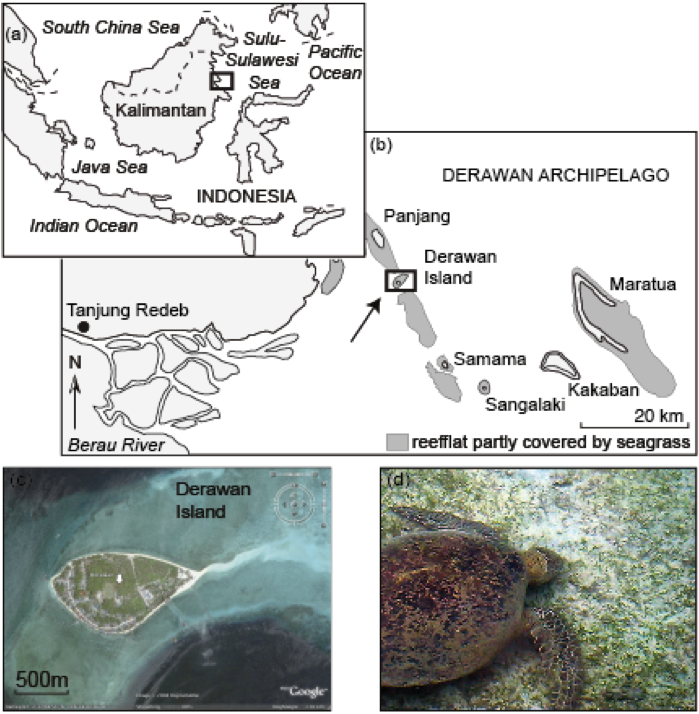
The Derawan Archipelago, is a hotspot of biodiversity and located in front of the Berau River on the mainland of East Kalimantan, Indonesia. In recent decades the once pristine rainforest and mangroves have been quickly transformed into palm oil plantations, coal mines and shrimp farms. Since all this activity is concentrated around the rivers it expected that the adjacent estuary will experience great effects of the increasing sediment and nutrient loads that will negatively affect the marine life & biodiversity of the adjacent estuary. So what is the effect of this on the seagrasses here?

(a) Map of the a Indo-Pacific Ocean with (b) The Derawan Archipelago and the (c) location of the exclosures on Derawan Island (d) Leaves are intensively grazed by green turtles, and a detritus layer is absent.

Following a pilot expedition of a Dutch group of marine biologists in 2003, we started with a 5 year PhD project in cooperation with the Indonesian Institute of Sciences (LIPI) and based ourselves on the small & beautiful Island of Derawan. The island is surrounded by a large shallow area (light-blue in picture c above) which is dominated by a mono species Halodule univervis meadow. On the other islands of the archipelago you can also find other species like Cymodocea rotundata, Cymodocea serrulata, Halophyla ovalis (with very rare dugong tracks), Enhalus acoroides, Thalassia hemprichii, Syringodium isoetifolium.

We found that the effect of increasing nutrient loads proved to be much less than the effect of the local grazers. Directly after arrival I was amazed by the extremely shortly grazed leaved, that were also very thin. It just looks like there is someone mowing the underwater seagrass lawns every day. And the extremely high densities of green turtles (Chelonia mydas) were found responsible for this. In our latest paper (Christianen et al. 2011, Journal of Ecology, link http://onlinelibrary.wiley.com/doi/10.1111/j.1365-2745.2011.01900.x/citedby) we estimated that these hungry grazers graze 100% of the daily primairy production of the seagrass meadow.While populations of green turtle have dramatically declined at most other places, green turtle hotspots like Derawan could teach us about the historical role of the role of these megaherbivores. The green turtle not only drives structure and functioning of their foraging ground but also increases the tolerance of seagrass ecosystems to eutrophication (Christianen et al. 2011).

It is not difficult to spot green turtles grazing around the island

The majority of our fieldwork on Derawan focuses on unraveling the interactions between seagrasses, turtle grazing and increasing nutrient loads. A fancy fieldwork station is lacking but this stimulates to interact a lot with the (families of the) local fisherman that have a lot of knowledge about the ecosystems.

On a small island with 1500 people we always have enough attention from the local kids (left). Daily fieldwork life, working on exclosures 400 meters offshore of the island (right)

Working on such a remote island is amazing because you are surrounded by marine life such as green turtles, mantas, dolphins, frog fish, and (my favorite) the robust ghost pipefish (looks like a Thalassia leaf). But on the other hand you also have to plan your experiment well and buy your materials a full day travelling away, or even further. And don’t step in a stingray like I did because this will definitely slow down your fieldwork.

180 degrees panorama from the Telkom tower
Categories
Notes from the field

Notes from the field: Cyrene Reef, Singapore

Every fortnight we feature a seagrass meadow from around the world. This week, Ria Tan takes us on a tour of Cyrene Reef in Singapore. Ria is an avid naturalist and runs the wildsingapore webpage. In addition to hanging out in seagrass meadows, she enjoys exploring new intertidal reefs and has recently taken to trudging around in mangroves.

————————

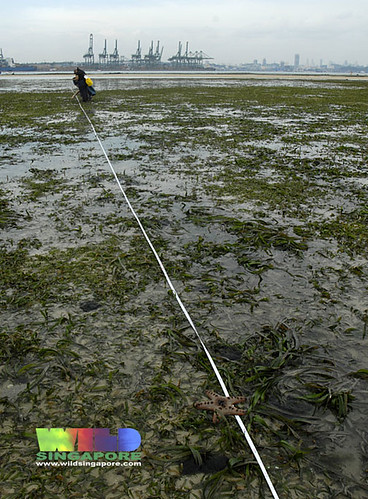
People normally assume that the best seagrass meadows are found in shallow, sheltered, clear waters far away from human impact and industry. That’s not the case in Singapore, a small island nation sitting at the tip of the Malayan Peninsular. One of Singapore’s best seagrass meadows is surrounded by massive petrochemical industries, a world class container terminal and major shipping lanes in one of the world’s busiest ports. Cyrene Reef is a 1km by 500m submerged reef with astonishing marine biodiversity!

http://www.flickr.com/photos/wildsingapore/3722430121/
http://farm4.static.flickr.com/3496/3722430121_a0440b9486.jpg
3722430121_a0440b9486.jpg

On one side of the Triangle is Pulau Bukom, the site of Singapore’s first oil refinery, set up in 1961 by Shell. Today, the 500,000 barrels-per-day Bukom Refinery is the largest Shell refinery in the world, in terms of crude distillation capacity. On another side of the Triangle are the massive heavy industries on Jurong Island encompassing a wide variety of installations. Some industrial activities that can potentially impact marine life include flaring. Developed in 1974, the Pasir Panjang Container Terminal is the largest of Singapore’s four terminals. Together, the terminals handle about one-fifth of the world’s total container transhipment. Cyrene is at a key maritime crossroads where east-west traffic routes cross north-south traffic routes. About five hundred ships in excess of 5,000 DWT per day transit the waters around the Reefs.
industrialtriangle.jpg

Despite it’s location in the middle of this ‘Industrial Triangle’, Cyrene Reef is home to vast meadows with 7 seagrass species! Long ribbons of Enhalus acoroides are particularly spectacular when in bloom!
http://www.flickr.com/photos/wildsingapore/2291422760/
http://farm4.static.flickr.com/3155/2291422760_2176cd0f2f.jpg
2291422760_2176cd0f2f.jpg

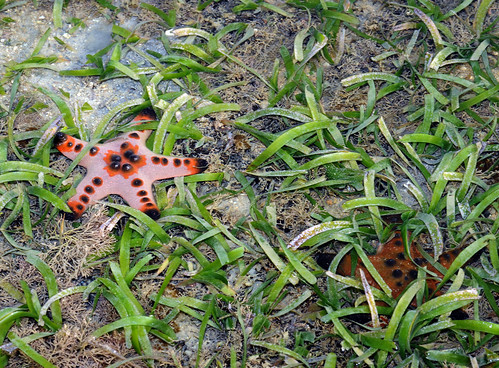
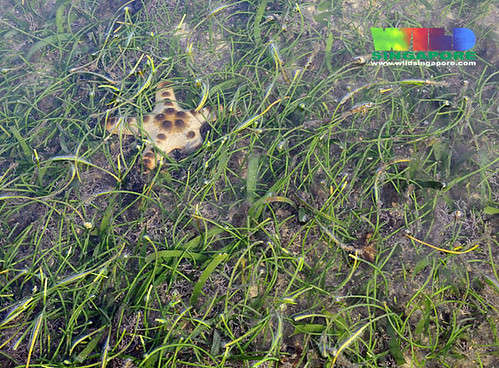
Cymodocea serrulata covers large areas of Cyrene Reef. These seagrass meadows are home to large numbers of Knobbly sea stars (Protoreaster nodosus). A study of these sea stars found that the presence of juveniles, subadults and adults, which indicates a healthy level of recruitment at Cyrene Reef. And that Cyrene Reef may be the only sustainable population of knobbly seastars left in Singapore today.
http://www.flickr.com/photos/wildsingapore/2884908620/
http://farm4.static.flickr.com/3045/2884908620_34e5e2cebc.jpg
2884908620_34e5e2cebc.jpg

Cyrene is one of the few locations in Singapore where Syringodium isoetifolium is abundant. Other seagrass species on Cyrene include Cymodocea rotundata, Thalassia hemprichii, Halodule uninervis and Halophila ovalis.
http://www.flickr.com/photos/wildsingapore/4893420536/
http://farm5.static.flickr.com/4097/4893420536_3b8d972bbf.jpg
4893420536_3b8d972bbf.jpg

Besides massive industries, frequent dredging also takes place near Cyrene Reef. Meanwhile, further reclamation is being considered at nearby Jurong Island. Just last week, a large fire broke out at the Shell refinery on Pulau Bukom close to Cyrene Reef. The fire raged for 30 hours before it was put out. It remains to be seen whether this massive industrial accident has impacted marine life on Cyrene Reef.
http://www.flickr.com/photos/wildsingapore/5972221362/
http://farm7.static.flickr.com/6142/5972221362_9a774c9540.jpg
5972221362_9a774c9540.jpg
Cyrene Reef is one of the major sites monitored by the volunteers of TeamSeagrass, a collaboration with the National Parks Board
(NParks) and international Seagrass-Watch, the largest scientific,non-destructive, seagrass assessment and monitoring program in the world. TeamSeagrass includes about 100 volunteers from all walks of life who have been monitoring Singapore’s meadows since 2007. The data they collect is submitted to NParks for a better understanding and management of Singapore’s seagrasses and shores, and to Seagrass-Watch thus contributing to global understanding of the world’s seagrasses.
http://www.flickr.com/photos/wildsingapore/3129983657/
http://farm4.static.flickr.com/3231/3129983657_33f671fb27.jpg
3129983657_33f671fb27.jpg
TeamSeagrass also gives ordinary people the opportunity to see first hand, some of Singapore’s best shores. Volunteers also have the satisfaction of making a difference for Singapore’s marine biodiversity.

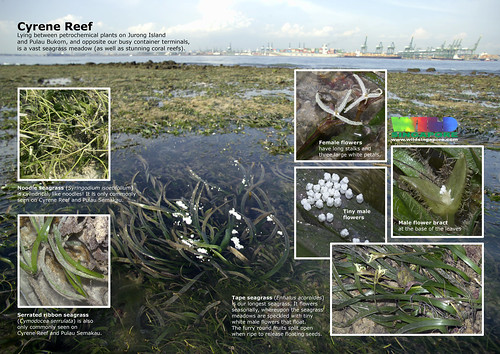
Besides monitoring, TeamSeagrass volunteers also participate in other outreach efforts such as public exhibitions and in giving talks. TeamSeagrass also has a blog and facebook page for online outreach. This is one of the posters of seagrasses on Cyrene used in TeamSeagrass public exhibitions.
http://www.flickr.com/photos/wildsingapore/2337022294/
http://farm4.static.flickr.com/3031/2337022294_a370068630.jpg

2337022294_a370068630.jpg

There is also an effort by a small team of volunteers to raise awareness of Cyrene Reef. The focus currently is to bring decision makers and selected corporations to visit the Reef and see it for themselves. Thus far, visits have been arranged for the Urban Redevelopment Authority, NParks and JTC (which manages Jurong Island).

Hopefully, these and other efforts to document and share Cyrene’s treasures will help protect this miraculous reef in the middle of an Industrial Triangle!

Find out more about Cyrene Reef and Singapore’s seagrasses at these sites
TeamSeagrass http://teamseagrass.blogspot.com/
Cyrene Reef Exposed http://cyrenereef.blogspot.com/

Categories
Notes from the field

Notes from the Field: Calvi Bay, Corsica

This is a the first of a series of fortnightly articles featuring seagrass meadows around the world. This week, Dorothée Pête of the University of Liege takes us to Calvi Bay in Corsica, which is one of her research field sites.
———————–
By Dorothée Péte

Although it’s nearest water body is the river Meuse, the University of Liege in Belgium has always had a strong interest in marine sciences. To strengthen the link between Liege and the sea, a research station was built in the late sixties, in Calvi Bay in Corsica, France. This research station with a catchy acronym – STARESO which stands for STAtion de REcherches Sous-marines et Océanographiques – which in English means “Station for underwater and oceanographic research” is a base for marine research carried out by the University.

Map of Calvi Bay (taken from Google Earth) showing the locations of STARESO, Punta Oscellucia, sewage outfall area, zone where Caluerpa racemosa was identified and location of fish farms. and other seagrass sites in the locality.

Calvi Bay is a wonderful place for studying seagrasses in the Mediterranean. It has two species of seagrasses, Posidonia oceanica (which is endemic to the Mediterranean Sea) and Cymodocea nodosa. This bay is of particular interest because all the major threats present in the Mediterranean Sea can be found in such a small area – making it a natural choice for studying impacts via field experiments. Plus, the view is spectacular both above and below water so you can easily understand why our lab (Laboratory of Oceanology) is working there and why I wanted to write a note to explain our field work.

Calvi Bay, Corsica - the view above water

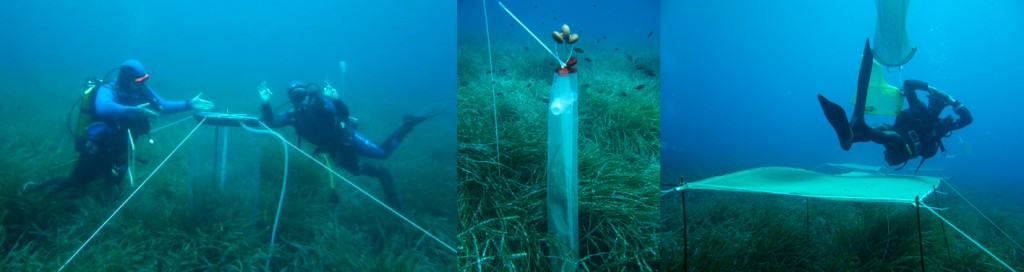
Let’s begin with the STARESO. In front of the research station, you can find a continuous meadow of P. oceanica. This seagrass canbe found from near the surface (5 m depth in STARESO) to about 40 m depth, so scuba diving is essential if you want to work in this meadow. The meadow at the STARESO site is a reference one, thanks to its good state of health. Our lab has been following it for years, with a particular focus on the seagrass itself (its growth, density and leaf litter accumulations), but also on its epiphytes, nutrients and trace elements contents, food webs and on organisms living in the sediment. Of course, environmental parameters such as nutrients in surrounding and pore waters and temperature are monitored as well. The meadow is also part of the SeagrassNet monitoring program. In situ experiments like shading, microcosms, sediment loading and nutrients and trace elements dynamics (e.g. inside isolated jars) are being carried out there too.

Studies being carried out in Calvi Bay (from L-R): Nutrient dynamics, microcosm experiments and shading experiments


Just next to STARESO, near Punta Oscellucia, large amount of underwater leaf litter accumulations are present and are exported onto the surrounding beaches and there are currently studies focused on the dynamics of those litter patches and organisms living inside them.

Seagrass wrack accumulations off Punta Oscellucia

Sadly, it’s not all about beautiful seagrass and crystal clear waters in Calvi Bay as there are quite a number of threats in the area. It is widely known that the Mediterranean Sea is a major tourist attraction and a hub for marine recreation. In summer, tourists from all over the world invade the city of Calvi, causing direct stress to the seagrasses there through activities such as yachting but also indirectly due to increased sewage, which is another important (although slightly less glamorous) topic that our lab is studying by looking at the zones of the seagrass meadow situated near the sewege outfalls from Calvi.

Fish farming activities have been increasing in the Mediterranean Sea, and Calvi Bay has a small aquaculture industry. It is situated above a P. oceanica bed but it is fortunately quite well managed, so the impact on the meadow is very small. However, we are also studying the P. oceanica ecosystem in that zone for a better understanding of fish farming impacts.

Fish Farms floating in the waters off Calvi Bay.

The last (but not least!) threat that was identified very recently in Calvi Bay is the presence of an invasive seaweed species Caulerpa racemosa. We are just beginning to work on that subject and for now, it looks like it shouldn’t be a problem for P. oceanica in that zone. However, in other parts of the Mediterranean Sea, invasive seaweeds are causing more and more troubles to seagrass meadows. They are taking over areas formerly colonized by large beds of seagrasses and seem more resistant to environmental impacts than the seagrasses. In that way, they are becoming a threat for the coastal biodiversity of the Mediterranean by causing modifications in the habitats of numerous organisms (some of which are commercially important species) and a switch in communities, leading to a decrease in biodiversity.

I hope that I have convinced you how lucky we are to have such a nice site for field work, but if you want to see more and learn more about STARESO and the awesome people in my lab working seagrasses, please visit our website and check out the links below:

Laboratory of Oceanography, University of Liege:

http://www2.ulg.ac.be/oceanbio/Page%20acceuil_ENG.html

STARESO:

http://www.stareso.ulg.ac.be/Stareso/Stareso.html

http://www.stareso.com/