Categories
Uncategorized

In memoriam: Evamaria Koch

Today we mourn the passing of one of our own in the seagrass community, Evamaria Koch. Below is a letter from WSA President, Giuseppe Di Carlo.

———————————————————

19 March 2014

Dear friends and colleagues,

I am writing to some share some terrible news. On Thursday evening (March 13, 2014) our dear friend Evamaria Koch passed away.

Eva bravely fought lung cancer for a year, then most recently, the cancer spread further until nothing more could be done.

eva3I cannot tell you the sadness I felt when I heard this news, which landed completely unexpected, as Eva chose not to share news about her health with colleagues. Most of you know how much I cared for Evamaria. She was a close friend and a mentor for me. I remember when I was still a PhD student, how much she supported me from afar, and she and I coauthored my first peer‐review publication. In 2005, Eva convinced me to move to the US to take a position at UMCES on the eastern shore of Maryland. That choice shaped much of my career from there onwards. When I arrived in the US, Evamaria was the only person I knew, and she was for a while, my family. I will never forget spending time with both Eva and her daughter Olga. Evamaria and I shared many great moments, sampling seagrasses in the Chesapeake Bay, traveling to conferences and spending time discussing research ideas at all hours of the day. I even remember celebrating Italy’s World Cup win in 2006 with Eva and Olga, together with Tim Carruthers and many other friends at UMCES. I am sure that you all have similar memories.

Aside from my personal considerations, Evamaria was an internationally respected scientist. She had a PhD in Marine Sciences from the University of South Florida and she held the position of Assistant Professor at Horn Point Laboratory – UMCES since 1995 and she then became Associate professor in 2001. Eva published more than 50 papers, of which two in the journal Science, on seagrasses with a specific focus on coastal protection, hydrodynamics and seagrass‐sediment interactions.

eva1Eva’s favourite quote was “If we knew what it was we were doing, it would not be called research, would it?” by Albert Einstein. This demonstrates her passion for science and specifically for seagrasses. Eva enjoyed tremendously spending time fleshing out new ideas and projects, SCUBA diving on seagrass beds and setting up experiments. I remember the many fun days spent on a boat in the Chesapeake Bay just like I will never forget how she proved me wrong on a number of theories about the effects of temperature and sediments on seagrasses.

Eva mentored a large number of students, masters and PhDs, and always dedicated herself to teaching both in the USA, Zanzibar and Brazil. Eva was a supporter of global science initiatives, believing in the need to establish collaboration across countries and continents. For this reason she supervised students oversees, and in 2006 she co‐organised the 7th International Seagrass Biology Workshop. In addition, Eva was one of the pioneers of global seagrass monitoring networks, working with Fred Short, Rob Coles and Miguel Fortes in establishing and running SeagrassNet, a project she strongly believed in.

eva2As for the WSA, Evamaria participated actively in the governance of WSA, being a founding member of the Association and a Steering Committee member since 2002. She always attended meetings and contributed to building the Association to what it is today. We are proud to have had the pleasure to cross paths with such a talented and dedicated person.

I will always remember Eva and I will continue to dedicate to her my passion and knowledge of seagrasses. I hope you will join me in taking a moment for Eva, in memory of all the good moments we lived with her and to reflect on what are the things in life that count the most.

For those who knew Eva and would like to share their stories and memories, WSA would be happy to collect these to share with Eva’s family and particularly for her daughter, whom we are sure will eventually want to hear what a great scientist her mother was. For those who would like to make a donation in Eva’s name, her family has selected the World Seagrass Association to collect these donations. The WSA will establish the “Evamaria Koch student travel fund” in memory of Evamaria. This award will assist students to attend future ISBWs.

The thoughts and condolences of the WSA go to Eva’s family and most especially to Olga, Eva’s daughter.

I wish you all the best,


Dr. Giuseppe Di Carlo

President

World Seagrass Association Inc.

—————————————————-

Categories
Uncategorized

WSA website and blog downtime

The WSA website and blog were hacked in mid-January and although no data was lost nor was there any confidential information at risk it caused a bit of a mess. The blog has been reinstated and the main site has been rebuilt from scratch.

Ainsley

Categories
Notes from the field Uncategorized

Notes from the field: Yellow River Delta, China

Every so often (but only as often as we receive contributions) we feature a seagrass meadow from around the world. This week, Laura Soissons shares her observations of her field site in the Yellow River Delta in China. Laura is a PhD student with the Royal Netherlands Institute for Sea Research (NIOZ-Yerseke) studying human impacts on seagrass.

———————————————————

Photos & text by Laura Soissons

“Where are the seagrasses?” This is the main question my colleagues and I had in mind last summer when we were visiting our field site in the Yellow River Delta area in China. Sadly enough, we haven’t seen them make a comeback.

Seagrasses in the Yellow River Delta are the main topic of a collaborative project between the Royal Netherlands Institute for Sea Research (NIOZ-Yerseke) and the Yantai Institute for Coastal Zone Research (YIC-CAS) in China founded by the NSFC-NWO. As part of this project, my PhD research is, in a broad perspective, looking at the impact of human activities on seagrasses and how these activities can affect their resilience to environmental stresses. Our first and main focus is to understand the recent seagrass decline in the Yellow River Delta area.

And this is where the story starts…

When we first visited the area in 2011, we found a small and declining seagrass meadow southward of the Yellow river mouth, surrounded by dikes, oil platforms and salt industries. We called it: YR5.

Pumpjacks, oil platforms and salt evaporation ponds on the coastline surrounding the seagrass meadow


The meadow was composed of a single seagrass species: Zostera japonica and showed a sparse and poor distribution over the tidal flat.

One patch of the Zostera japonica meadow in May 2011 at YR5


We progressively learnt about the recent dike construction around the area that cut kilometres of the tidal flat, and thus changed the whole shape of the area. We also discovered some interesting and dominant species like the snail Bullacta exarata, which is invading the entire area and used for aquaculture. Further research on this snail showed us that it originates from Korea and arrived in the area in 2008 after being placed and cultured there by humans for food. It mainly feeds on diatoms and organic matter at the sediment surface but not on seagrasses. Nevertheless, this species is now colonizing the entire tidal flat and remains one of the last living species there (together with crabs and a few bivalves).

The snail Bullacta exarata (Philippi, 1848) at YR5


Back to the YR5 field site at the end of May 2012, we had hard times finding the seagrasses. After hours of searching we finally found some even scarcer shoots in an area surrounded by the saltmarsh plant Spartina anglica in tussocks (invasive plant in that area). Local temperatures were already high enough to think that the seagrasses were late for the growing season… And when we looked at the shoots in more details, we saw how unhealthy they were: holes in the leaves, black leaves and very weak tissues.

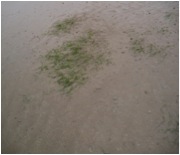
Left over of the seagrass meadow in May 2012 (zoom on seagrass shoots from the same place)

Two weeks after this discovery, we came back to the exact same place. We found only dead rhizomes, and just a couple of shoots left with more black leaves than before. We even felt very guilty for having been sampling a few shoots two weeks before (samples for tissue analysis, trace elements and pollutants content).

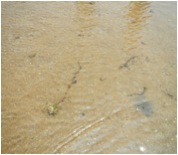
June 2012 – dead rhizomes at YR5 as the only remaining of the seagrass meadow

We observed a highly dynamic system over the summer with strong winds and waves at high tide. Sediment was getting coarser and accreting, sometimes burying the seagrass shoots. For our final visit at the end of July, no seagrasses were left. The dead rhizomes were washed away or already degraded and the hours we spent looking for seagrasses remained unsuccessful.

There are many reasons that could explain the sudden collapse of this Zostera japonica meadow at YR5. It could be the anthropogenic influence but also a combination of changing environmental variables and pollution from the Yellow River and surroundings. So far, we found no historical data reporting the existence of this meadow or anything related to the status of this particular tidal flat before the dike construction in 2009 (from what we know). Observing the seagrass meadow decline over its ‘growing season’ showed us one more time how crucial it is to take into account our long-term influence on a meadow. Stakeholders in that area will not give up on expanding their activities but also want to consider their impact and the need to preserve their environment. Within our project we want to emphasize this seagrass loss by understanding more about the reasons of their decline and how we made it happen.

Categories
Uncategorized

Possible zoophilous pollination of turtlegrass by marine invertebrates

By Brigit van Tussenbroek

Small invertebrates play a central role in seagrass communities as controllers of epiphyton and conduits for energy transfer from primary producers to higher trophic levels. Van Tussenbroek and collaborators at the National Autonomous University of Mexico, highlight a new interaction between meso-grazers and seagrasses by describing the foraging of invertebrates on the pollen/mucilage masses of the seagrass Thalassia testudinum during the night.

Male turtlegrass flower with invertebrate.

The fauna visiting the flowers was highly diverse 252 specimens belonging to 37 families and 57 species of crustaceans (Classes Maxillopoda, Ostracoda and Malacostraca) were found on 76 flowers, and 15 species were new records for the region. Annelids (mainly polychaetes) were less abundant (60 specimens) and diversified (13 species) and they exhibited no obvious differences in their visits to flowers with or without pollen. Negative consequences for reproductive success of the seagrass of the consumption of pollen by the invertebrates were most likely insignificant, because the quantities of removed pollen were very small. However, these invertebrates may serve as pollinators of T. testudinum, which if confirmed, makes this observation the first record of animal-pollination in the marine environment.

Check out the YouTube video

Find the paper in MEPS

Categories
Uncategorized

Election for WSA Executive (2012)

Dear WSA members,

The period for nomination for the next WSA Executive was extended, and closed on the 5 December, 2012.

The positions of Vice-President, Treasurer and Secretary are uncontested with single nominees for each position. The nominations received are as follows:

Vice-President: Richard Unsworth
Nominator: Len McKenzie
Seconder: Giuseppe Di Carlo

Treasurer: Jessie Jarvis
Nominator: Giuseppe Di Carlo
Seconder: Len McKenzie

Secretary: Len McKenzie
Nominator: Rob Coles
Seconder: Rudi Yoshida

There are two nominees for President so this position will be decided by a vote:

Nomination 1

Giuseppe Di Carlo
Nominator: Len McKenzie
Seconder: Richard Unsworth

Nomination 2

Mike van Keulen
Nominator: Anitra Thorhaug
Seconder: Evamaria Koch

Voting is now open but will close on the 19 December, 2012 — so please do not delay in submitting your ballot. Please note that only current financial members of the WSA are allowed to participate in this vote. Members have been emailed directly with instructions on how to cast their ballot, if you have not received instructions about voting please contact the WSA Secretary ASAP < wsa.secretary@gmail.com >.

Categories
Uncategorized

“Seagrass meadows in a globally changing environment” WSA Special Issue in Marine Pollution Bulletin

Dear Members

We would like to invite all members of the World Seagrass Association to submit articles for a WSA special issue of the journal Marine Pollution Bulletin titled “Seagrass meadows in a globally changing environment”.

A description of the special issue and its proposed content is listed below.

The special issue will be edited by myself, Rob Coles and Mike van Keulen. All submissions would need to be completed by the end of February, and we encourage potential authors to submit proposed titles (with a brief summary) to us asap.

We look forward to hearing from you!

Kind regards,
Richard Unsworth
Vice-President, WSA Inc.


Marine Pollution Bulletin Special Issue
Seagrass meadows in a globally changing environment
Proposed Editors: Richard Unsworth, Rob Coles, Mike Van Keulen
Overview
Seagrass meadows are valuable ecosystem service providers that may have a greater resilience to future environmental change than many marine habitats. Unfortunately these habitats of high functional importance are now being lost globally at an unprecedented rate, with water quality and other localised stressors putting their future viability in doubt. It is therefore critical that we learn more about the interactions between seagrass meadows and future environmental change in the anthropocene. This needs to be with particular reference to the consequences of poor water quality on ecosystem resilience and the effects of change on trophic interactions within the food web. Understanding and predicting the response of seagrass meadows to future environmental change requires an understanding of the natural long-term drivers of change and how these are currently influenced by anthropogenic stress. Conservation management of coastal and marine ecosystems now and in the future requires increased knowledge of how seagrass meadows respond to environmental change, and how they can be managed to be resilient to these changes. The proposed special issue aims to further enhance this knowledge by bringing together global expertise across this field and will solicit primary research and review articles. The proposed special issue would be in collaboration with the World Seagrass Association and would cover the following areas:

  • Understanding seagrass ecosystem resilience and adaptations in a globally changing environment
  • The impact of future climate on trophic interactions and habitat value within the seagrass food web
  • Quantifying and modelling the carbon sequestration capacity of seagrass meadows
  • Climate and ocean acidifications interactions with water quality and its impact on seagrass
  • Drivers of change within seagrass landscapes, and approaches to quantifying and modelling those drivers
  • Understanding risk in the management of seagrass meadows
  • Socio-economic consequences of environmental change to seagrass
  • Indigenous communities and seagrass conservation

Proposed timetable:
Invitation to submit articles: September 2012
Article submission deadline: February 2013
Reviews complete: July 2013
Estimated special issue publication Sept 2013

Categories
Notes from the field Uncategorized

Notes from the Field: North Wales, United Kingdom

Every fortnight (or so we hope) we feature a seagrass meadow from around the world. This week, Rosemary Mc Closkey writes about her field site in Porth Dinllaen in North Wales. Rosemary is currently a Masters student at Swansea University and she is studying juvenile fish populations in Zostera marina meadows. 

——————————————————————-

Photos and text by Rosemary Mc Closkey

I am a student from Swansea University and I am currently undertaking a month of field work for my Master’s thesis, where I am studying juvenile fish populations in a Zostera marina seagrass meadow in Porth Dinllaen on the Llŷn peninsula, North Wales. My data collection has been carried out alongside and with the support of an on-going collaborative project between SEACAMS and the National Trust here in Wales.

Seagrass bed at Porth Dinllaen on low water

I first visited the site with SEACAMS at the end of April this year to assist with their fish monitoring work and to assess some scarring of the bed caused by moorings in the bay. This also allowed me to get the ‘lay of the land’ so to speak, and to design the methodology for my project. I joined SEACAMS once more in June to carry out more work and to run trials on some small fish traps designed to catch shrimp and small fish. Unfortunately these yielded very little success and as I had yet to visit this site on the low spring tides, I was keen to return for an extended period so I could get a real feel for the site and to adjust my method.  Myself and a field assistant returned to Porth Dinllaen at the start of August with a smaller, lighter seine net with a finer mesh than that which I had used with SEACAMS in April and June. These nets seem to be working successfully and selecting the age/size classes that I wanted.

My research thus far is focused on assessing sites of varying complexity and heterogeneity within the meadow in order to elucidate whether small-scale variations within the bed affects species assemblages. During the 1st week of August, low water on spring tide caused the bed to become exposed, thus allowing some assistants and myself to carry out a habitat assessment.

Carrying out habitat assessment on the Z. marina bed

Plots of 36m2 were assessed and permanently marked out using marker pegs and GPS. Detailed photographs were also taken. I was initially skeptical as to whether or not the heavy duty orange pegs I had used to mark out the plots would last, but I was pleasantly surprised to see most of them have. They have proven very useful for relocating each plot. The main working hazard in that respect has been young kids stealing them for their sandcastles!

I have fished within each of the plots using an 8m beach seine net to assess the dominant species and size classes of juvenile fish. Initially I wasn’t sure whether I would catch the same species that were caught in the much larger seine net. I have found that I am catching all the same species as before, however the majority are juveniles, small fish and shrimps. The larger, fast moving finfish and bigger predators seem to evade the smaller net! The majority of the fish caught were wrasses, gobies, dragonets, sea scorpions, plaice, sticklebacks and pollack. We have also caught the slightly more elusive species such as little cuttlefish and pipefish.

Greater pipefish (Syngnathus acus). One of the many beautiful creatures in the Porth Dinllaen seagrass bed.

I plan to stay one more week at this beautiful location to collect some more fishing data. Getting access to the site for this length of time has been a real joy and I have been very fortunate to be able to carry out extended field work of this nature for my masters project. I look forward to returning to Swansea in order to write up my results and my thesis.

For more information on The National Trust: http://www.nationaltrust.org.uk/
For more information on SEACAMS: http://www.swan.ac.uk/seacams/

Categories
Uncategorized

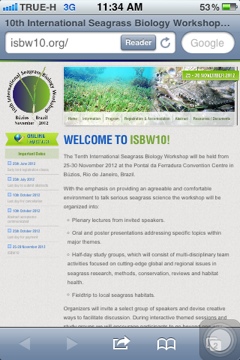
ISBW10 is coming!

Website for ISBW10 is up! click here

20120509-113624.jpg

Categories
Uncategorized

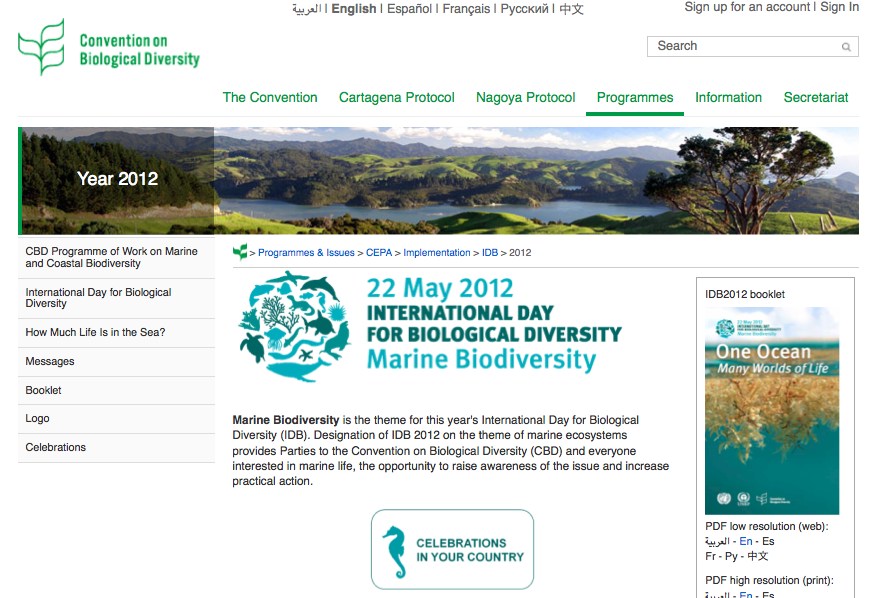
International Day for Biodiversity, 22nd May 2012

This year’s theme for International Day for Biodiversity is Marine Biodiversity. The WSA blog will be featuring a series of articles on seagrass this month so watch this space!

Visit the Convention on Biological Diversity page here.

Categories
Uncategorized

10th International Seagrass Biology Workshop Announcement

What a great start to 2012! Joel Creed has posted the announcement for the 10th ISBW to be held in Rio de Janeiro in November 2012. Read on for more details and don’t forget to register your interest with the email below or on the ISBW10 Facebook page!

————————————————–

Dear colleagues,

Apologies for cross posting.

The State University of Rio de Janeiro and the Institute for Brazilian
Marine Biodiversity will be hosting the Tenth International Seagrass
Biology Workshop from 25-30 November 2012 at the Pontal da Ferradura
Convention Centre in Búzios, Rio de Janeiro, Brazil.

With the emphasis on providing an agreeable and comfortable environment to
talk serious seagrass science the workshop will be organized into:

Plenary lectures from invited speakers

Oral and poster presentations addressing specific topics within major themes

Half-day study groups, which will consist of multi-disciplinary team
activities focused on cutting-edge global and regional issues in seagrass
research, methods, conservation, reviews and habitat health

Fieldtrip to local seagrass habitats

Organizers will invite a select group of speakers and devise creative ways
to facilitate discussion. During interactive themed sessions and study
groups we will encourage participants to go beyond one-way communication.

The Workshop will open on 25th November with an evening reception at the
Pontal da Ferradura Convention Centre in Búzios. The event will close on
the evening of 29th November with a final reception.

The International Seagrass Biology Workshops have been held since 1993 when
the first meeting took place in Kominato, Japan. The International Seagrass
Biology Workshop (ISBW) is an official activity of the World Seagrass
Association Inc.

Don’t miss the opportunity to be a part of the next International Seagrass
Biology Workshop!

Please register your interest by replying to
isbw10@biodiversidademarinha.org.br or on Facebook (isbw10) for further
announcements and updates.

A website with more info will be available soon.

Local Organizing Committee

———————————————

More details:

ISBW10 on Facebook: https://www.facebook.com/pages/Isbw10/184950924937571?sk=wall