Categories
Notes from the field

Notes from the field: Akumal Bay, Mexico.

Every fortnight we feature a seagrass meadow from around the world. This week, Elizabeth ‘Z’ Lacey writes about Akumal Bay, an ecosystem in the Caribbean off the coast of Mexico. Z is finishing her Ph.D. at Florida International University in Miami, Florida.
—————————————
Photos and text by Z Lacey

I have a confession.  I did not go to Akumal Bay to study the seagrass beds; I went to study the coral reefs.  Before you kick me off the World Seagrass Association blog, hear me out.  I first came to Akumal Bay, Quintana Roo, Mexico to study the return of an important herbivore to the coral reef community BUT I was quickly and irreversibly intrigued by the seagrass beds and the graceful green sea turtles in short order.  Does that redeem me in your eyes, fellow seagrass lovers?

A typical weekend in Akumal Bay: lots of tourists and fishing boats!

But I get ahead of myself.  Let me introduce you to a beautiful place that I’ve been working in for the past four years.  Akumal Bay is located along the MesoAmerican Reef on the Yucatan Peninsula of Mexico and its name means ‘place of the turtles’ in Mayan.  It is a unique environment as it’s one of the few public access beaches for locals as well as serves the surrounding tourist populations coming from Playa del Carmen, Tulum and Cancun.  There are lots of interested stakeholders, which is a challenge for the managers of this important ecosystem.  Incredibly this bay is monitored by the non-governmental organization Centro Ecologico Akumal (www.ceakumal.org) and Director Paul Sanchez-Navarro.  They rely heavily on donations and volunteer stewards to monitor the coral reefs, water quality and abundant turtle population.  To do this they hold turtle walks, give informative lectures in the education center, run a recycling program, provide life jackets/snorkeling vests and many other initiatives, all free of charge to visitors and the residents of the nearby pueblos.

Lush T. testudinum, S. filiforme and H. wrightii bed
A patch of seagrass dominated by the calcareous green algae, Halimeda

Unlike Siti’s last post on the diversity of species to be found in South Sulawesi, the seagrass meadows in Akumal typically consist of just three seagrasses: Thalassia testudinum, Syringodium filiforme and sparse Halodule wrightii intermixed with calcareous green macroalgae.  The seagrass beds are patchy throughout the lagoon from the shoreline to the reef approximately 250 meters offshore.  In some areas of the bay, patch reefs are interspersed throughout the seagrass meadow, providing refuge for fish, urchins and other diverse marine life.

A green sea turtle Chelonia mydas: caught in the act!
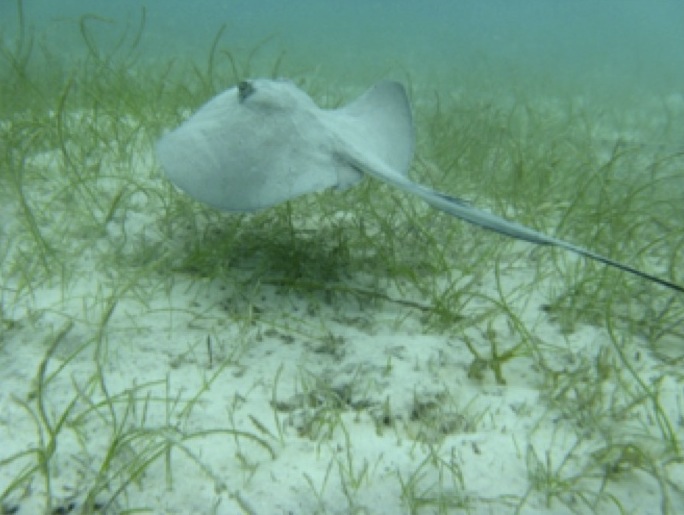
A southern stingray Dasyatis americana taking flight over a bed of S. filiforme

Akumal Bay is easily accessible by tourists groups from land as well as those entering on boats via the channel through the adjacent barrier reef.  Part of my research is considering this impact by humans on the seagrass beds and how the herbivores, both sea turtles and fish, have shaped this ecosystem.  Similar to other regions along the Mayan Riviera, this area is experiencing dramatic population growth and even further tourism development.  While the fate of these seagrass beds is unknown, change is inevitable.  CEA is in a difficult position as they try to protect the ecosystem with their limited financial resources while also listening to the needs of the local residents, tour operators and businesses, which rely on the bay mainly for tourism income rather than as a food source.

Yvonne, a volunteer seagrass ranger, harvesting some samples

Volunteers come from all around the world for a three month adventure at CEA and learn skills such as coral reef identification and sea turtle tracking.  Throughout the years I’ve had volunteers from France, Netherlands, Germany, the Philippines and of course Mexico as they assist in my research along with their other volunteer duties.  For some, such as my new friend Yvonne Kleinschmidt pictured here, they were completely unaware of the different types of seagrass before I took them into the field to make them honorary seagrass rangers.  It’s been fun for me to teach workshops on identifying seagrass and macroalgae to the volunteers as part of their reef monitoring training.


Hiking to the top of Coba, one of the many Mayan ruins in the region

Before you think it’s all work and no play in Akumal, I have to mention the many Mayan ruins to explore, cenotes to swim in and cities like Playa del Carmen to visit!  Not to mention the amazing local cuisine and fresh fruits and veggies available at the farmer’s market in the town square.  A day off from the field is rich in cultural experiences as well as ecological discovery – another reason I’ve come back to Akumal year after year.  And while I initially studied the coral reefs, you can see how the interesting marine life living within the seagrass beds and the stories waiting to be explored were able to pull me into Akumal Bay!


Categories
Notes from the field

Notes from the Field: Barang Lompo, South Sulawesi

Every fortnight we feature a seagrass meadow from around the world. This week, I thought I’d take a stab at writing about a recent trip I made to a seagrass meadow on a sand cay called Barang Lompo in South Sulawesi.

By Siti M. Yaakub (text) & Marjolijn Christianen (photos)

The Spermonde Archipelago is the stuff of seagrass legends. I say this because I’ve heard it talked about A LOT. The area has had a long succession of seagrass researchers (mostly Dutch) conducting their studies in the area. So when I got to tag along with Marjolijn (Mayo) and her two masters students Peter and Iris to visit some seagrasses off Makassar in South Sulawesi, I was pretty darn excited. We set off early from the hotel and after haggling for a boat, we set off for Barang Lompo, which is a coral island just north west of the town of Ujung Pandang in Makassar. In just under an hour (which is pretty impressive for our tiny vessel) we were there.

Location of Barang Lompo off the coast of Makassar. (Maps courtesy of Google Earth)

You know that feeling you get when you come across a seagrass meadow you haven’t been to before? You’re peering into the water, and you’re met with a carpet of awesome green, your heart leaps and you get tingles down your spine in anticipation of what you might find, and all you wanna do is jump right in and swim around like a crazed person checking off the number of species of seagrass you can find? That’s pretty much what happened.

The meadow didn’t disappoint, we spent a very happy hour or so exploring, ID-ing seagrass and checking out the cool critters going about their daily business.

Peter, Iris and I compaing notes on species we've found.


The meadow was predominantly Enhalus acoroides, Halodule uninervis and Thalassia hemprichii with lots of Halophila ovalis in between.


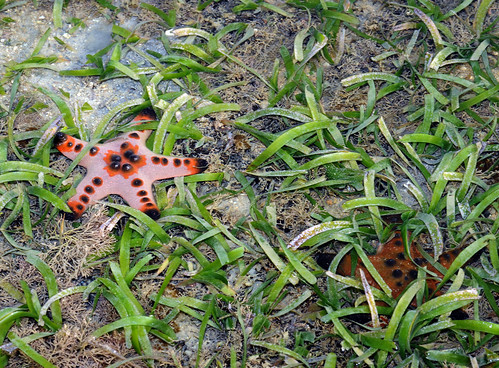
It was knobbly sea star heaven
Is that a Halodule leaf the knobbly sea star is munching on?
A friendly fisherman came to sell us his catch of the day
A habitat for juvenile fish indeed!
Lobster mounds
Urchins of all sorts were very common throughout the seagrass bed

After an hour or so of swimming, we were getting hungry, so we got back onto the boat and headed to a nearby island called Bono Batang to grab some lunch. Mayo was hoping to catch a glimpse of some turtles, but the tide was pretty low so chances of finding grazing turtles in the seagrass is pretty low.

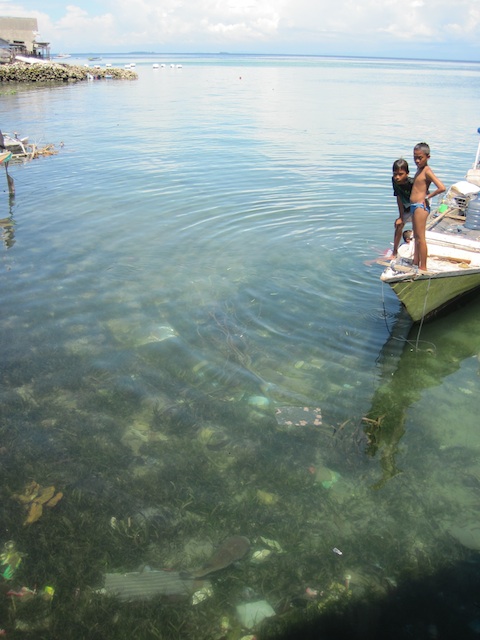
When we got to the island, there was some excitement at the jetty. A couple of local boys had spotted a very large puffer fish in the seagrass surrounding the jetty and were taking turns diving in after it.

Boys and the lone (and probably lost) puffer fish

After lunch, we took a short stroll to a shop near the jetty, which turned out to be a souvenir shop – selling stuff collected from the sea. We had a quick chat with the owner and Mayo asked him about the occurrence of green turtles in the area, turns out there haven’t been green turtle sightings in decades! Lots of Hawksbills but no Greens 🙁

Mayo having a chat with the shop owner. Above her hands the skeleton of a dugong and hanging on the pillar to her right is a preserved turtle that's for sale to tourists.

When asked about the turtles he has for sale, the owner said that they are no longer allowed to catch turtles in the waters around the area and that the existing stock he has in his shop are all from before the new law was passed. We also learned that turtle meat is sometimes used as filler in local dishes because it’s cheaper than beef.

A preserved and dried turtle hatchling

As we walked back to the jetty, we came across a rather disturbing sight. Marine rubbish was strewn everywhere along the shore. Turns out that there isn’t a proper waste disposal system on the island and it all goes into the sea. A sobering note to leave on, given that these islands are very densely populated. As we left you can actually see the impact marine litter is having on the seagrass beds just adjacent to the island. Will this be the fate of Barang Lompo as well?

Rubbish in the seagrass beds growing in the waters off the island.

————————————————————–

If you think that the SE Asian seagrass beds are over-represented on this blog, you’re absolutely right. I mean they’re awesome and all, but we are sorely lacking contributions from our North and South American, Mediterranean, African and Australian counterparts. I have to rely on YOU for these because much as I’d like to go around and snorkel/swim/dive/walk in all the seagrass beds in the world, I have supervisors to answer to and like most PhD students, a lack of funds. So please help me keep this blog alive and going! Send me your articles! The rest of the world, REPRESENT!! Love, Siti 🙂
Categories
Notes from the field

Notes from the Field: Tinggi Island, Peninsular Malaysia

Every fortnight we feature a seagrass meadow from around the world. This week, Jillian Ooi writes about Pulau Tinggi, an island off the east coast of Peninsular Malaysia. Jillian has just recently completed her PhD at the University of Western Australia in Perth and is now based at the University of Malaya, in Kuala Lumpur.When she’s not grass-watching, she plays the gamelan with Rhythm in Bronze, a gong chime ensemble in Malaysia.
—————————————–
By Jillian Ooi
Photos courtesy of Affendi Yang Amri and Serina Rahman.

The first time I ventured into the seagrass meadows of Pulau Tinggi was in 2005. Back then, we were tracking the movement of dugongs in the area, but I became absolutely enchanted by the meadow itself.

It was like a magical garden filled with wonderful critters everywhere I looked. Golden sea cucumbers, knobbly sea stars, sea hares, green turtles, black tip sharks, and my favourite – the gobiid fishes and their associated burrowing shrimps, are some of the reasons I jumped at the chance of going back there for my PhD in seagrass biogeography three years later.

Pulau Tinggi is a marine park island located 12 km off the southeast coast of Peninsular Malaysia. In Malay, tinggi means ‘tall’. This island was named for its 600 m high peak shaped like a Mandarin’s hat. In olden days, Pulau Tinggi was a stopover point for spice traders. Today, it is sparsely inhabited and relatively undeveloped (i.e. no large luxury resorts as of 2010, although I hear plans are underway for some).

Pulau Tinggi, located off the southeast coast of Peninsular Malaysia, has a rich seagrass system in the forereef zone.
Our trusty boat, Gloria, skippered by Eddie, a local villager. In the background is the high peak of Pulau Tinggi.

Its villagers rely on home-stay programmes targeted mainly at recreational fishermen.  Its seagrass meadows are really something else. Mixed stands of Halophila ovalis, Halophila decipiens, Halophila minor, Halophila spinulosa, Halodule uninervis, Syringodium isoetifolium and Cymodocea serrulata grow in the area between the coral reef and sea. These forereef meadows are interesting because they comprise mainly small, fast-growing species growing in deeper waters and on unconsolidated sandy substrate. In most other Southeast Asian meadows, back reef meadows dominated by Enhalus acoroides and Thalassia hemprichii are the better known systems (Ooi et al 2011, Estuarine, Coastal and Shelf Science).

Cuttlefish found in seagrass meadows of Pulau Tinggi


Gobiid fish and burrowing shrimps

We found numerous dugong feeding trails, and frequently sighted dugongs surfacing around our boat. As a result, colleagues working on the Dugong dugon are now starting to turn their attention towards the Pulau Tinggi group of islands. Burrowing shrimp mounds are also common, and I was finding new mounds created almost daily in my study plots. Does this type of small-scale sediment burial kill the seagrasses? Yes it does, if a mound stays intact for at least 4 weeks. However, burial has more of an effect on small and ‘selfish’ species such as Halophila ovalis and Halodule uninervis (Ooi et al 2011, Continental Shelf Research). In comparison, larger species such as Cymodocea serrulata and Syringodium isoetifolium appear to survive burial better because they transfer resources to buried shoots.


So far, the main seagrass meadows on the south-western side of Pulau Tinggi have been mapped using tow underwater video in 2009. Plans are in place to set up permanent monitoring sites in the coral reefs and seagrass meadows to collect long-term data. Together with collaborators at the University of Western Australia, we are also continuing to develop models to understand the distribution patterns of the main seagrass species in relation to sediment properties.

The underwater world is not the only reason for my fond memories of Pulau Tinggi. We lodged with a local family who took us out to sea, filled our dive tanks, let us watch the World Cup on their TV, and welcomed us at a family member’s wedding.

Research facilities were basic, but I managed by converting the family’s grocery shop into a makeshift lab. The matriarch, Maksu, kept our spirits up by plying us with freshly-caught fish and sambal belachan, chilli donuts, fried bananas, fresh coconut juice, pressed rice topped with a thick chilli peanut sauce, durian porridge, and keropok lekor (something like a fish sausage is how I would describe it). On days off, we’d trek to our private waterfall to soothe our aching muscles and visit the resident Malayan soft-shelled turtle there.

But what does the future hold for the seagrasses in Pulau Tinggi? There are plans for a luxury resort, a jetty, and a kelong (a traditional fishing platform on stilts) in the vicinity of the meadow I studied. Thus, changes are inevitable. As development extends gradually across Pulau Tinggi and its surrounding islands, anthropogenic impacts on seagrasses will become evident. For this reason, it is important that our work here continues.

On days off, we trekked up the hill to our own private waterfall and pool.
Categories
Notes from the field

Notes from the Field: Derawan Island, Indonesia

Every fortnight we feature a seagrass meadow from around the world. This week, Marjolijn Christianen shares her experiences working in the beautiful tropical island of Derawan in Indonesia. Marjolijn is currently a PhD student at Radboud University in The Netherlands. She has a blog detailing her experiences working with turtles and seagrass.
——————————-

by Marjolijn Christianen

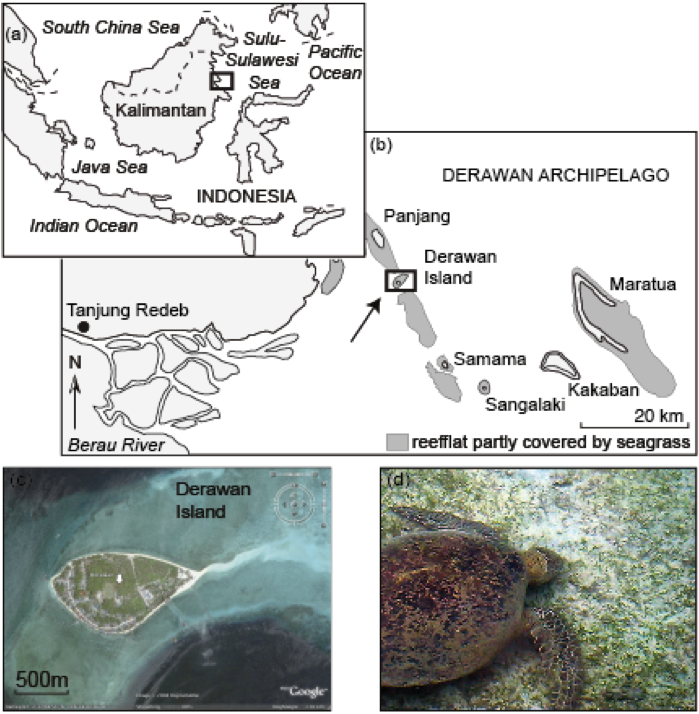
The Derawan Archipelago, is a hotspot of biodiversity and located in front of the Berau River on the mainland of East Kalimantan, Indonesia. In recent decades the once pristine rainforest and mangroves have been quickly transformed into palm oil plantations, coal mines and shrimp farms. Since all this activity is concentrated around the rivers it expected that the adjacent estuary will experience great effects of the increasing sediment and nutrient loads that will negatively affect the marine life & biodiversity of the adjacent estuary. So what is the effect of this on the seagrasses here?

(a) Map of the a Indo-Pacific Ocean with (b) The Derawan Archipelago and the (c) location of the exclosures on Derawan Island (d) Leaves are intensively grazed by green turtles, and a detritus layer is absent.

Following a pilot expedition of a Dutch group of marine biologists in 2003, we started with a 5 year PhD project in cooperation with the Indonesian Institute of Sciences (LIPI) and based ourselves on the small & beautiful Island of Derawan. The island is surrounded by a large shallow area (light-blue in picture c above) which is dominated by a mono species Halodule univervis meadow. On the other islands of the archipelago you can also find other species like Cymodocea rotundata, Cymodocea serrulata, Halophyla ovalis (with very rare dugong tracks), Enhalus acoroides, Thalassia hemprichii, Syringodium isoetifolium.

We found that the effect of increasing nutrient loads proved to be much less than the effect of the local grazers. Directly after arrival I was amazed by the extremely shortly grazed leaved, that were also very thin. It just looks like there is someone mowing the underwater seagrass lawns every day. And the extremely high densities of green turtles (Chelonia mydas) were found responsible for this. In our latest paper (Christianen et al. 2011, Journal of Ecology, link http://onlinelibrary.wiley.com/doi/10.1111/j.1365-2745.2011.01900.x/citedby) we estimated that these hungry grazers graze 100% of the daily primairy production of the seagrass meadow.While populations of green turtle have dramatically declined at most other places, green turtle hotspots like Derawan could teach us about the historical role of the role of these megaherbivores. The green turtle not only drives structure and functioning of their foraging ground but also increases the tolerance of seagrass ecosystems to eutrophication (Christianen et al. 2011).

It is not difficult to spot green turtles grazing around the island

The majority of our fieldwork on Derawan focuses on unraveling the interactions between seagrasses, turtle grazing and increasing nutrient loads. A fancy fieldwork station is lacking but this stimulates to interact a lot with the (families of the) local fisherman that have a lot of knowledge about the ecosystems.

On a small island with 1500 people we always have enough attention from the local kids (left). Daily fieldwork life, working on exclosures 400 meters offshore of the island (right)

Working on such a remote island is amazing because you are surrounded by marine life such as green turtles, mantas, dolphins, frog fish, and (my favorite) the robust ghost pipefish (looks like a Thalassia leaf). But on the other hand you also have to plan your experiment well and buy your materials a full day travelling away, or even further. And don’t step in a stingray like I did because this will definitely slow down your fieldwork.

180 degrees panorama from the Telkom tower
Categories
Notes from the field

Notes from the field: Cyrene Reef, Singapore

Every fortnight we feature a seagrass meadow from around the world. This week, Ria Tan takes us on a tour of Cyrene Reef in Singapore. Ria is an avid naturalist and runs the wildsingapore webpage. In addition to hanging out in seagrass meadows, she enjoys exploring new intertidal reefs and has recently taken to trudging around in mangroves.

————————

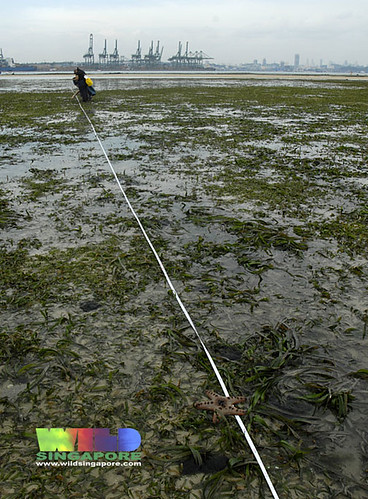
People normally assume that the best seagrass meadows are found in shallow, sheltered, clear waters far away from human impact and industry. That’s not the case in Singapore, a small island nation sitting at the tip of the Malayan Peninsular. One of Singapore’s best seagrass meadows is surrounded by massive petrochemical industries, a world class container terminal and major shipping lanes in one of the world’s busiest ports. Cyrene Reef is a 1km by 500m submerged reef with astonishing marine biodiversity!

http://www.flickr.com/photos/wildsingapore/3722430121/
http://farm4.static.flickr.com/3496/3722430121_a0440b9486.jpg
3722430121_a0440b9486.jpg

On one side of the Triangle is Pulau Bukom, the site of Singapore’s first oil refinery, set up in 1961 by Shell. Today, the 500,000 barrels-per-day Bukom Refinery is the largest Shell refinery in the world, in terms of crude distillation capacity. On another side of the Triangle are the massive heavy industries on Jurong Island encompassing a wide variety of installations. Some industrial activities that can potentially impact marine life include flaring. Developed in 1974, the Pasir Panjang Container Terminal is the largest of Singapore’s four terminals. Together, the terminals handle about one-fifth of the world’s total container transhipment. Cyrene is at a key maritime crossroads where east-west traffic routes cross north-south traffic routes. About five hundred ships in excess of 5,000 DWT per day transit the waters around the Reefs.
industrialtriangle.jpg

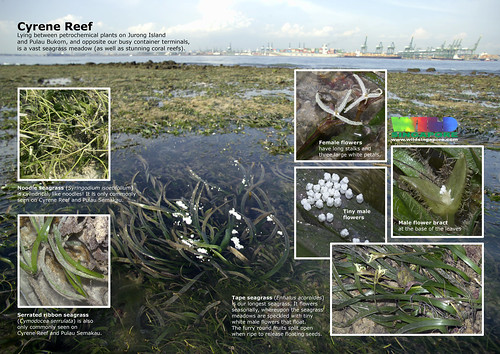
Despite it’s location in the middle of this ‘Industrial Triangle’, Cyrene Reef is home to vast meadows with 7 seagrass species! Long ribbons of Enhalus acoroides are particularly spectacular when in bloom!
http://www.flickr.com/photos/wildsingapore/2291422760/
http://farm4.static.flickr.com/3155/2291422760_2176cd0f2f.jpg
2291422760_2176cd0f2f.jpg

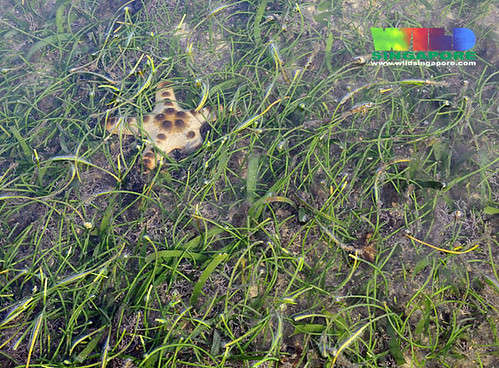
Cymodocea serrulata covers large areas of Cyrene Reef. These seagrass meadows are home to large numbers of Knobbly sea stars (Protoreaster nodosus). A study of these sea stars found that the presence of juveniles, subadults and adults, which indicates a healthy level of recruitment at Cyrene Reef. And that Cyrene Reef may be the only sustainable population of knobbly seastars left in Singapore today.
http://www.flickr.com/photos/wildsingapore/2884908620/
http://farm4.static.flickr.com/3045/2884908620_34e5e2cebc.jpg
2884908620_34e5e2cebc.jpg

Cyrene is one of the few locations in Singapore where Syringodium isoetifolium is abundant. Other seagrass species on Cyrene include Cymodocea rotundata, Thalassia hemprichii, Halodule uninervis and Halophila ovalis.
http://www.flickr.com/photos/wildsingapore/4893420536/
http://farm5.static.flickr.com/4097/4893420536_3b8d972bbf.jpg
4893420536_3b8d972bbf.jpg

Besides massive industries, frequent dredging also takes place near Cyrene Reef. Meanwhile, further reclamation is being considered at nearby Jurong Island. Just last week, a large fire broke out at the Shell refinery on Pulau Bukom close to Cyrene Reef. The fire raged for 30 hours before it was put out. It remains to be seen whether this massive industrial accident has impacted marine life on Cyrene Reef.
http://www.flickr.com/photos/wildsingapore/5972221362/
http://farm7.static.flickr.com/6142/5972221362_9a774c9540.jpg
5972221362_9a774c9540.jpg
Cyrene Reef is one of the major sites monitored by the volunteers of TeamSeagrass, a collaboration with the National Parks Board
(NParks) and international Seagrass-Watch, the largest scientific,non-destructive, seagrass assessment and monitoring program in the world. TeamSeagrass includes about 100 volunteers from all walks of life who have been monitoring Singapore’s meadows since 2007. The data they collect is submitted to NParks for a better understanding and management of Singapore’s seagrasses and shores, and to Seagrass-Watch thus contributing to global understanding of the world’s seagrasses.
http://www.flickr.com/photos/wildsingapore/3129983657/
http://farm4.static.flickr.com/3231/3129983657_33f671fb27.jpg
3129983657_33f671fb27.jpg
TeamSeagrass also gives ordinary people the opportunity to see first hand, some of Singapore’s best shores. Volunteers also have the satisfaction of making a difference for Singapore’s marine biodiversity.

Besides monitoring, TeamSeagrass volunteers also participate in other outreach efforts such as public exhibitions and in giving talks. TeamSeagrass also has a blog and facebook page for online outreach. This is one of the posters of seagrasses on Cyrene used in TeamSeagrass public exhibitions.
http://www.flickr.com/photos/wildsingapore/2337022294/
http://farm4.static.flickr.com/3031/2337022294_a370068630.jpg

2337022294_a370068630.jpg

There is also an effort by a small team of volunteers to raise awareness of Cyrene Reef. The focus currently is to bring decision makers and selected corporations to visit the Reef and see it for themselves. Thus far, visits have been arranged for the Urban Redevelopment Authority, NParks and JTC (which manages Jurong Island).

Hopefully, these and other efforts to document and share Cyrene’s treasures will help protect this miraculous reef in the middle of an Industrial Triangle!

Find out more about Cyrene Reef and Singapore’s seagrasses at these sites
TeamSeagrass http://teamseagrass.blogspot.com/
Cyrene Reef Exposed http://cyrenereef.blogspot.com/

Categories
Notes from the field

Notes from the Field: Calvi Bay, Corsica

This is a the first of a series of fortnightly articles featuring seagrass meadows around the world. This week, Dorothée Pête of the University of Liege takes us to Calvi Bay in Corsica, which is one of her research field sites.
———————–
By Dorothée Péte

Although it’s nearest water body is the river Meuse, the University of Liege in Belgium has always had a strong interest in marine sciences. To strengthen the link between Liege and the sea, a research station was built in the late sixties, in Calvi Bay in Corsica, France. This research station with a catchy acronym – STARESO which stands for STAtion de REcherches Sous-marines et Océanographiques – which in English means “Station for underwater and oceanographic research” is a base for marine research carried out by the University.

Map of Calvi Bay (taken from Google Earth) showing the locations of STARESO, Punta Oscellucia, sewage outfall area, zone where Caluerpa racemosa was identified and location of fish farms. and other seagrass sites in the locality.

Calvi Bay is a wonderful place for studying seagrasses in the Mediterranean. It has two species of seagrasses, Posidonia oceanica (which is endemic to the Mediterranean Sea) and Cymodocea nodosa. This bay is of particular interest because all the major threats present in the Mediterranean Sea can be found in such a small area – making it a natural choice for studying impacts via field experiments. Plus, the view is spectacular both above and below water so you can easily understand why our lab (Laboratory of Oceanology) is working there and why I wanted to write a note to explain our field work.

Calvi Bay, Corsica - the view above water

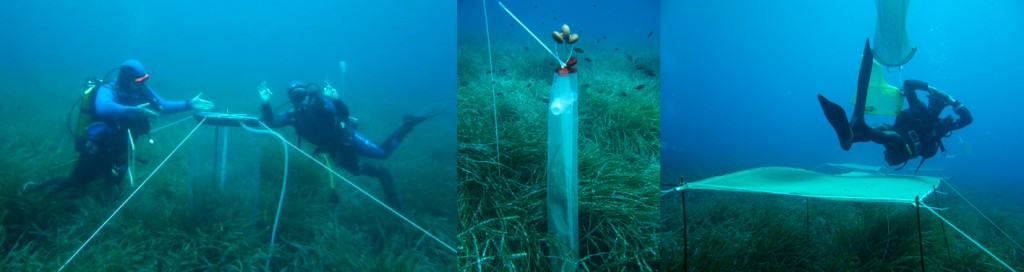
Let’s begin with the STARESO. In front of the research station, you can find a continuous meadow of P. oceanica. This seagrass canbe found from near the surface (5 m depth in STARESO) to about 40 m depth, so scuba diving is essential if you want to work in this meadow. The meadow at the STARESO site is a reference one, thanks to its good state of health. Our lab has been following it for years, with a particular focus on the seagrass itself (its growth, density and leaf litter accumulations), but also on its epiphytes, nutrients and trace elements contents, food webs and on organisms living in the sediment. Of course, environmental parameters such as nutrients in surrounding and pore waters and temperature are monitored as well. The meadow is also part of the SeagrassNet monitoring program. In situ experiments like shading, microcosms, sediment loading and nutrients and trace elements dynamics (e.g. inside isolated jars) are being carried out there too.

Studies being carried out in Calvi Bay (from L-R): Nutrient dynamics, microcosm experiments and shading experiments


Just next to STARESO, near Punta Oscellucia, large amount of underwater leaf litter accumulations are present and are exported onto the surrounding beaches and there are currently studies focused on the dynamics of those litter patches and organisms living inside them.

Seagrass wrack accumulations off Punta Oscellucia

Sadly, it’s not all about beautiful seagrass and crystal clear waters in Calvi Bay as there are quite a number of threats in the area. It is widely known that the Mediterranean Sea is a major tourist attraction and a hub for marine recreation. In summer, tourists from all over the world invade the city of Calvi, causing direct stress to the seagrasses there through activities such as yachting but also indirectly due to increased sewage, which is another important (although slightly less glamorous) topic that our lab is studying by looking at the zones of the seagrass meadow situated near the sewege outfalls from Calvi.

Fish farming activities have been increasing in the Mediterranean Sea, and Calvi Bay has a small aquaculture industry. It is situated above a P. oceanica bed but it is fortunately quite well managed, so the impact on the meadow is very small. However, we are also studying the P. oceanica ecosystem in that zone for a better understanding of fish farming impacts.

Fish Farms floating in the waters off Calvi Bay.

The last (but not least!) threat that was identified very recently in Calvi Bay is the presence of an invasive seaweed species Caulerpa racemosa. We are just beginning to work on that subject and for now, it looks like it shouldn’t be a problem for P. oceanica in that zone. However, in other parts of the Mediterranean Sea, invasive seaweeds are causing more and more troubles to seagrass meadows. They are taking over areas formerly colonized by large beds of seagrasses and seem more resistant to environmental impacts than the seagrasses. In that way, they are becoming a threat for the coastal biodiversity of the Mediterranean by causing modifications in the habitats of numerous organisms (some of which are commercially important species) and a switch in communities, leading to a decrease in biodiversity.

I hope that I have convinced you how lucky we are to have such a nice site for field work, but if you want to see more and learn more about STARESO and the awesome people in my lab working seagrasses, please visit our website and check out the links below:

Laboratory of Oceanography, University of Liege:

http://www2.ulg.ac.be/oceanbio/Page%20acceuil_ENG.html

STARESO:

http://www.stareso.ulg.ac.be/Stareso/Stareso.html

http://www.stareso.com/