Anchana has been featured on Ocean Voices on the SeaWeb. Find out what inspires her on the feature article:
http://www.seaweb.org/getinvolved/oceanvoices/AchanaPrathep.php

Anchana has been featured on Ocean Voices on the SeaWeb. Find out what inspires her on the feature article:
http://www.seaweb.org/getinvolved/oceanvoices/AchanaPrathep.php
November is seagrass month on SeaWeb and to kick off a great theme for a great month, SeaWeb will be featuring interviews with seagrass scientists as part of this initiative so head on over to the SeaWeb website to check it out!
SeaWeb

by Marjolijn Christianen
The Derawan Archipelago, is a hotspot of biodiversity and located in front of the Berau River on the mainland of East Kalimantan, Indonesia. In recent decades the once pristine rainforest and mangroves have been quickly transformed into palm oil plantations, coal mines and shrimp farms. Since all this activity is concentrated around the rivers it expected that the adjacent estuary will experience great effects of the increasing sediment and nutrient loads that will negatively affect the marine life & biodiversity of the adjacent estuary. So what is the effect of this on the seagrasses here?
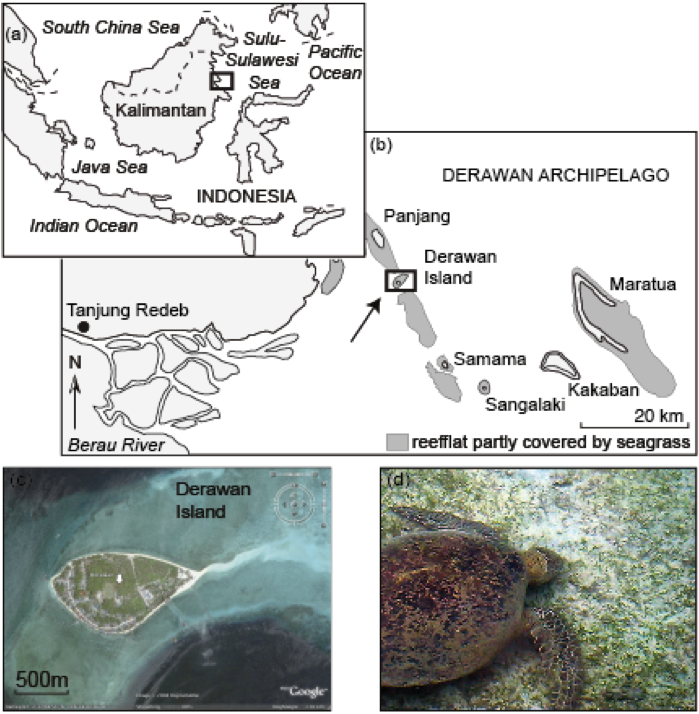
Following a pilot expedition of a Dutch group of marine biologists in 2003, we started with a 5 year PhD project in cooperation with the Indonesian Institute of Sciences (LIPI) and based ourselves on the small & beautiful Island of Derawan. The island is surrounded by a large shallow area (light-blue in picture c above) which is dominated by a mono species Halodule univervis meadow. On the other islands of the archipelago you can also find other species like Cymodocea rotundata, Cymodocea serrulata, Halophyla ovalis (with very rare dugong tracks), Enhalus acoroides, Thalassia hemprichii, Syringodium isoetifolium.
We found that the effect of increasing nutrient loads proved to be much less than the effect of the local grazers. Directly after arrival I was amazed by the extremely shortly grazed leaved, that were also very thin. It just looks like there is someone mowing the underwater seagrass lawns every day. And the extremely high densities of green turtles (Chelonia mydas) were found responsible for this. In our latest paper (Christianen et al. 2011, Journal of Ecology, link http://onlinelibrary.wiley.com/doi/10.1111/j.1365-2745.2011.01900.x/citedby) we estimated that these hungry grazers graze 100% of the daily primairy production of the seagrass meadow.While populations of green turtle have dramatically declined at most other places, green turtle hotspots like Derawan could teach us about the historical role of the role of these megaherbivores. The green turtle not only drives structure and functioning of their foraging ground but also increases the tolerance of seagrass ecosystems to eutrophication (Christianen et al. 2011).

The majority of our fieldwork on Derawan focuses on unraveling the interactions between seagrasses, turtle grazing and increasing nutrient loads. A fancy fieldwork station is lacking but this stimulates to interact a lot with the (families of the) local fisherman that have a lot of knowledge about the ecosystems.

Working on such a remote island is amazing because you are surrounded by marine life such as green turtles, mantas, dolphins, frog fish, and (my favorite) the robust ghost pipefish (looks like a Thalassia leaf). But on the other hand you also have to plan your experiment well and buy your materials a full day travelling away, or even further. And don’t step in a stingray like I did because this will definitely slow down your fieldwork.

————————
People normally assume that the best seagrass meadows are found in shallow, sheltered, clear waters far away from human impact and industry. That’s not the case in Singapore, a small island nation sitting at the tip of the Malayan Peninsular. One of Singapore’s best seagrass meadows is surrounded by massive petrochemical industries, a world class container terminal and major shipping lanes in one of the world’s busiest ports. Cyrene Reef is a 1km by 500m submerged reef with astonishing marine biodiversity!
http://www.flickr.com/photos/wildsingapore/3722430121/
http://farm4.static.flickr.com/3496/3722430121_a0440b9486.jpg

On one side of the Triangle is Pulau Bukom, the site of Singapore’s first oil refinery, set up in 1961 by Shell. Today, the 500,000 barrels-per-day Bukom Refinery is the largest Shell refinery in the world, in terms of crude distillation capacity. On another side of the Triangle are the massive heavy industries on Jurong Island encompassing a wide variety of installations. Some industrial activities that can potentially impact marine life include flaring. Developed in 1974, the Pasir Panjang Container Terminal is the largest of Singapore’s four terminals. Together, the terminals handle about one-fifth of the world’s total container transhipment. Cyrene is at a key maritime crossroads where east-west traffic routes cross north-south traffic routes. About five hundred ships in excess of 5,000 DWT per day transit the waters around the Reefs.
Despite it’s location in the middle of this ‘Industrial Triangle’, Cyrene Reef is home to vast meadows with 7 seagrass species! Long ribbons of Enhalus acoroides are particularly spectacular when in bloom!
http://www.flickr.com/photos/wildsingapore/2291422760/
http://farm4.static.flickr.com/3155/2291422760_2176cd0f2f.jpg

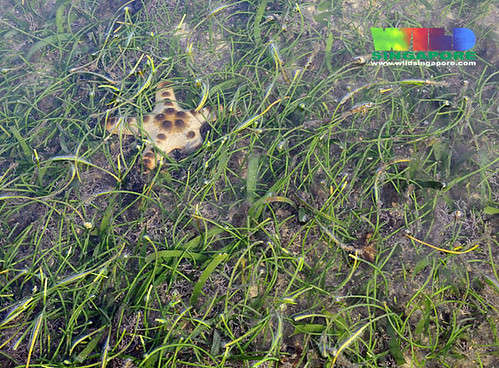
Cymodocea serrulata covers large areas of Cyrene Reef. These seagrass meadows are home to large numbers of Knobbly sea stars (Protoreaster nodosus). A study of these sea stars found that the presence of juveniles, subadults and adults, which indicates a healthy level of recruitment at Cyrene Reef. And that Cyrene Reef may be the only sustainable population of knobbly seastars left in Singapore today.
http://www.flickr.com/photos/wildsingapore/2884908620/
http://farm4.static.flickr.com/3045/2884908620_34e5e2cebc.jpg
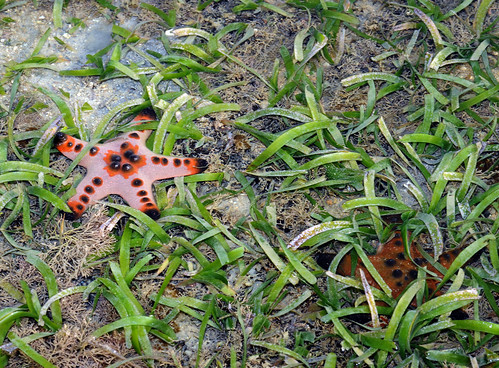
Cyrene is one of the few locations in Singapore where Syringodium isoetifolium is abundant. Other seagrass species on Cyrene include Cymodocea rotundata, Thalassia hemprichii, Halodule uninervis and Halophila ovalis.
http://www.flickr.com/photos/wildsingapore/4893420536/
http://farm5.static.flickr.com/4097/4893420536_3b8d972bbf.jpg
Besides massive industries, frequent dredging also takes place near Cyrene Reef. Meanwhile, further reclamation is being considered at nearby Jurong Island. Just last week, a large fire broke out at the Shell refinery on Pulau Bukom close to Cyrene Reef. The fire raged for 30 hours before it was put out. It remains to be seen whether this massive industrial accident has impacted marine life on Cyrene Reef.
http://www.flickr.com/photos/wildsingapore/5972221362/
http://farm7.static.flickr.com/6142/5972221362_9a774c9540.jpg

Cyrene Reef is one of the major sites monitored by the volunteers of TeamSeagrass, a collaboration with the National Parks Board
(NParks) and international Seagrass-Watch, the largest scientific,non-destructive, seagrass assessment and monitoring program in the world. TeamSeagrass includes about 100 volunteers from all walks of life who have been monitoring Singapore’s meadows since 2007. The data they collect is submitted to NParks for a better understanding and management of Singapore’s seagrasses and shores, and to Seagrass-Watch thus contributing to global understanding of the world’s seagrasses.
http://www.flickr.com/photos/wildsingapore/3129983657/
http://farm4.static.flickr.com/3231/3129983657_33f671fb27.jpg
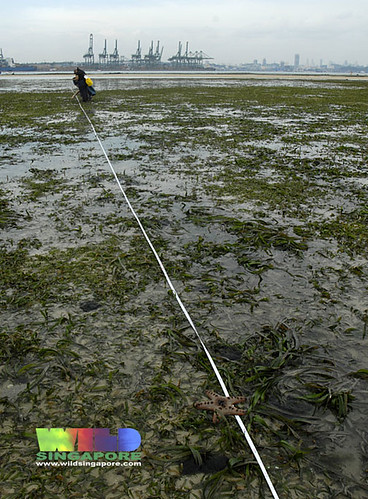
TeamSeagrass also gives ordinary people the opportunity to see first hand, some of Singapore’s best shores. Volunteers also have the satisfaction of making a difference for Singapore’s marine biodiversity.
Besides monitoring, TeamSeagrass volunteers also participate in other outreach efforts such as public exhibitions and in giving talks. TeamSeagrass also has a blog and facebook page for online outreach. This is one of the posters of seagrasses on Cyrene used in TeamSeagrass public exhibitions.
http://www.flickr.com/photos/wildsingapore/2337022294/
http://farm4.static.flickr.com/3031/2337022294_a370068630.jpg
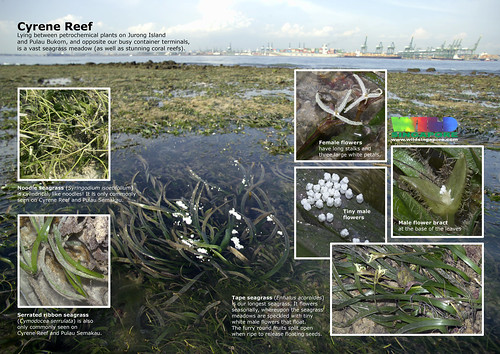
There is also an effort by a small team of volunteers to raise awareness of Cyrene Reef. The focus currently is to bring decision makers and selected corporations to visit the Reef and see it for themselves. Thus far, visits have been arranged for the Urban Redevelopment Authority, NParks and JTC (which manages Jurong Island).
Hopefully, these and other efforts to document and share Cyrene’s treasures will help protect this miraculous reef in the middle of an Industrial Triangle!
Find out more about Cyrene Reef and Singapore’s seagrasses at these sites
TeamSeagrass http://teamseagrass.blogspot.com/
Cyrene Reef Exposed http://cyrenereef.blogspot.com/
 A new manual aimed at building knowledge and raising awareness of seagrass habitats has hit the shelves (well not literally)! The training manual, titled “Seagrass Syllabus” was developed by The World Seagrass Association and Seagrass-Watch in partnership with Conservation International.
The Seagrass Syllabus is the first of a series of initiatives that the WSA is taking to increase the profile of seagrasses within the global conservation arena. Many WSA members contributed to creating and designing the manual, and the WSA welcomes suggestions to continue to improve on the manual.
Although aimed at resource managers, the manual is accessible enough for the general public and it represents a useful tool to ensure that seagrass ecosystems receive due attention so that their ecosystem services can be secured for the future. The Seagrass Syllabus is made freely available worldwide to continue to increase awareness on seagrass ecosystems, to educate the general public and to improve the management of this critical resource.
To download a copy of the seagrass syllabus, please visit the WSA website or at this direct link: http://wsa.seagrassonline.org/images/stories/download/Seagrass_Syllabus.pdf
Although it’s nearest water body is the river Meuse, the University of Liege in Belgium has always had a strong interest in marine sciences. To strengthen the link between Liege and the sea, a research station was built in the late sixties, in Calvi Bay in Corsica, France. This research station with a catchy acronym – STARESO which stands for STAtion de REcherches Sous-marines et Océanographiques – which in English means “Station for underwater and oceanographic research” is a base for marine research carried out by the University.

Calvi Bay is a wonderful place for studying seagrasses in the Mediterranean. It has two species of seagrasses, Posidonia oceanica (which is endemic to the Mediterranean Sea) and Cymodocea nodosa. This bay is of particular interest because all the major threats present in the Mediterranean Sea can be found in such a small area – making it a natural choice for studying impacts via field experiments. Plus, the view is spectacular both above and below water so you can easily understand why our lab (Laboratory of Oceanology) is working there and why I wanted to write a note to explain our field work.

Let’s begin with the STARESO. In front of the research station, you can find a continuous meadow of P. oceanica. This seagrass canbe found from near the surface (5 m depth in STARESO) to about 40 m depth, so scuba diving is essential if you want to work in this meadow. The meadow at the STARESO site is a reference one, thanks to its good state of health. Our lab has been following it for years, with a particular focus on the seagrass itself (its growth, density and leaf litter accumulations), but also on its epiphytes, nutrients and trace elements contents, food webs and on organisms living in the sediment. Of course, environmental parameters such as nutrients in surrounding and pore waters and temperature are monitored as well. The meadow is also part of the SeagrassNet monitoring program. In situ experiments like shading, microcosms, sediment loading and nutrients and trace elements dynamics (e.g. inside isolated jars) are being carried out there too.
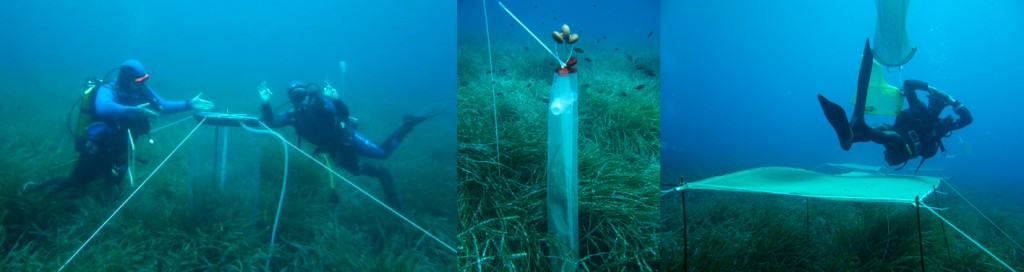
Just next to STARESO, near Punta Oscellucia, large amount of underwater leaf litter accumulations are present and are exported onto the surrounding beaches and there are currently studies focused on the dynamics of those litter patches and organisms living inside them.

Sadly, it’s not all about beautiful seagrass and crystal clear waters in Calvi Bay as there are quite a number of threats in the area. It is widely known that the Mediterranean Sea is a major tourist attraction and a hub for marine recreation. In summer, tourists from all over the world invade the city of Calvi, causing direct stress to the seagrasses there through activities such as yachting but also indirectly due to increased sewage, which is another important (although slightly less glamorous) topic that our lab is studying by looking at the zones of the seagrass meadow situated near the sewege outfalls from Calvi.
Fish farming activities have been increasing in the Mediterranean Sea, and Calvi Bay has a small aquaculture industry. It is situated above a P. oceanica bed but it is fortunately quite well managed, so the impact on the meadow is very small. However, we are also studying the P. oceanica ecosystem in that zone for a better understanding of fish farming impacts.

The last (but not least!) threat that was identified very recently in Calvi Bay is the presence of an invasive seaweed species Caulerpa racemosa. We are just beginning to work on that subject and for now, it looks like it shouldn’t be a problem for P. oceanica in that zone. However, in other parts of the Mediterranean Sea, invasive seaweeds are causing more and more troubles to seagrass meadows. They are taking over areas formerly colonized by large beds of seagrasses and seem more resistant to environmental impacts than the seagrasses. In that way, they are becoming a threat for the coastal biodiversity of the Mediterranean by causing modifications in the habitats of numerous organisms (some of which are commercially important species) and a switch in communities, leading to a decrease in biodiversity.
I hope that I have convinced you how lucky we are to have such a nice site for field work, but if you want to see more and learn more about STARESO and the awesome people in my lab working seagrasses, please visit our website and check out the links below:
Laboratory of Oceanography, University of Liege:
http://www2.ulg.ac.be/oceanbio/Page%20acceuil_ENG.html
STARESO:
Thanks to Klemens Gann, the WSA would like to share this seagrass video from the Philippines. If you have video you would like to share, please let us know.

To access the video click on the link below, and Enjoy!
Seagrass meadows around the world continue to be under threat from the activities of humans. Over fishing, climate change, coastal development, extreme weather and poor land management are all contributing to the continued global loss of these diverse and productive marine habitats that are critical for the continued functioning of the coastal environment and the services it provides.
Over the last decade a range of publications by leading global scientists have highlighted how governments, communities, industry and global conservation are failing to take the action necessary to prevent the further degradation of these important ecosystem service providers. Recent high profile research publications have shown how individual seagrass species are potentially under threat from extinction, whilst the global area of seagrass is being reduced at a rate of up to two soccer fields per hour.
Seagrass meadows are a valuable means of support for global food security due to their role as critically important nursery habitats for many of the world’s fisheries. They also directly provide fishery habitat and support endangered species such as the dugongs and green turtles. Seagrass meadows bubble oxygen into the water and sediments, sucking carbon dioxide from the atmosphere and cleaning the coastal environment of many pollutants. If current patterns of habitat loss coupled to the increasing influence of climate change are not controlled then the world faces a potentially future devoid of these productive, valuable and diverse habitats.
Not many people know what a seagrass meadow is, but it’s estimated that 1 billion people live within 50 km of one. Today, on World Oceans Day, scientists from the World Seagrass Association are seeking to highlight the value and threats to these meadows so that greater emphasis and resources are placed on their conservation.
To help save seagrasses into the future the World needs to:
Seagrasses in South Florida, the Florida Museum of Natural History
Seagrasses at CoSEE (The Centers for Ocean Sciences Education Excellence, University of Maryland Center for Environmental Science
Mediterranean Seagrass Ecosystem at MarBEF (Marine Biodiversity and Ecosystem Functioning)
Unsworth and Cullen (2010). “Recognising the necessity for Indo-Pacific seagrass conservation.” Conservation Letters 3(2): 63-73. Follow the link
Hughes et al (2009). “Associations of concern: declining seagrasses and threatened dependent species.” Frontiers in Ecology and the Environment 7(5): 242-246. Follow the link
Waycott et al. (2009). “Accelerating loss of seagrasses across the globe threatens coastal ecosystems.” Proceedings of the National Academy of Sciences of the United States of America 106(30): 12377-12381. Follow the Link
Duarte et al. (2008). The charisma of coastal ecosystems: addressing the imbalance. Estuaries and Coasts 31: 233–238 Follow the link
Orth et al (2006). A Global Crisis for Seagrass Ecosystems. Bioscience 56: 987–996 Follow the link
Frederick T. Short, Beth Polidoro, Suzanne R. Livingstone, Kent E. Carpenter, Salomão Bandeira, Japar Sidik Bujang, Hilconida P. Calumpong, Tim J.B. Carruthers, Robert G. Coles, William C. Dennison, Paul L.A. Erftemeijer, Miguel D. Fortes, Aaren S. Freeman, T.G. Jagtap, Abu Hena M. Kamal, Gary A. Kendrick, W. Judson Kenworthy, Yayu A. La Nafie, Ichwan M. Nasution, Robert J. Orth, et al. 2011. Extinction risk assessment of the world’s seagrass species. Biological Conservation, 144: 1961-1971
By Miguel Fortes
It is only very recently that the importance of protecting and restoring seagrass habitats has been clarified as a climate change mitigation strategy. Towards this end, Conservation International, IUCN, IOC‐UNESCO and partners are “building a program to coordinate and guide establishment of coastal ‘blue’ carbon as a conservation and management tool contributing to climate change mitigation and the development of associated conservation financing mechanisms”. The initial action in order to realize the program was the formation in February 2011 of the “Blue Carbon” International Scientific Working Group.
The group is tasked to:
Five of the 22 members of the working group are well known to us in the WSA and seagrass circle: Carlos M. Duarte, Miguel D. Fortes, Jim Fourqurean, Nuria Marba, and Peter Ralph. The working group is convened by Conservation International, International Union for Conservation of Nature, and the UNESCO Intergovernmental Oceanographic Commission. The Waterloo Foundation, NASA and UNEP have provided funding for the group.
The initial recommendations of the group are coming out soon in a pamphlet: “Minimizing Carbon Emissions and Maximizing Carbon Sequestration and Storage by Seagrasses, Tidal Marshes, Mangroves”. They embody the immediate steps that need to be taken by coastal communities, managers, policy makers and the scientific community. In brief, these steps are:


At the moment, the group is developing the Global Coastal Carbon Data Archive.
For more information:
Recommendations from the 1st meeting of the Blue Carbon Scientific Working group
Blue Carbon blog

